
by Handre on X @Handre “Spreading the radical ideas of the free market to 100m people before 2035. Let’s wipe collectivism from the face of the earth.”
Hayek and Keynes met in person, debated in print, and disagreed on nearly everything that matters in economics, and the consequences of that disagreement are still bleeding out of your tax bill today. The clash crystallized in 1931. Hayek arrived at the London School of Economics from Vienna, the University of London had just given him a visiting position, and his four-part review of Keynes’s Treatise on Money appeared in Economica. Keynes fired back. Both men were brilliant, both were prolific, and both understood that they were fighting over something fundamental: whether market prices carry real information, or whether a wise technocrat with a budget deficit can simply override them. Hayek said prices are signals produced by millions of individual decisions that no single mind can replicate. Keynes said the economy is a machine and the state can tune the throttle. One of these positions respects human knowledge. The other assumes the government knows your business better than you do. The irony Keynes fans never want to confront: Keynes himself, by 1946, was alarmed at where Keynesian policy was heading. He told Henry Clay at the Bank of England that he hoped markets would reassert themselves before his own ideas “did too much damage.” He died that April. His followers immediately ignored the warning and spent the next three decades engineering the stagflation of the 1970s, the Nixon wage-price controls of 1971, and the general wreckage that Hayek had predicted with embarrassing precision in 1931. Hayek won the Nobel in 1974. The prize committee gave it to him alongside Gunnar Myrdal, a committed social democrat, because they lacked the nerve to award a free market thinker alone. Even in Stockholm, the state needs a security blanket. The deeper issue is moral, not just technical. Every time a government “stimulates” the economy, it does so by extracting resources from producers through taxation or debasing the currency through credit expansion. The state is not a benevolent engineer: it is an institution that compels compliance at gunpoint, then calls the wealth they exctacted “revenue.” The pretense of knowledge is not merely an intellectual error, but the philosophical license for coercion. Every stimulus package passed since 2008 proves the lesson is still being refused.

Why Socialism Cannot Work. Ever. Mathematically.
Article 6/27 Vienna. 1919.
The Austro-Hungarian Empire has just collapsed. The war has been lost. The old order is gone, and what replaces it is not yet clear.
Hungary has already fallen to a communist revolution. Germany has seen one attempted. In Austria, socialist agitators are making their case in the streets while the government tries to hold the country together. Otto Neurath — philosopher, socialist, and true believer — has just published a pamphlet arguing that a centrally planned economy is not only possible but scientifically superior to the chaos of markets. The intellectual class is largely sympathetic. The historical moment feels decisive.
Ludwig von Mises, thirty-seven years old, veteran of the Eastern Front, economic adviser at the Vienna Chamber of Commerce, reads Neurath’s pamphlet. Then he sits down and writes the paper that should have stopped socialism in its tracks before it killed anyone.
He delivers it as a lecture in 1919. He publishes it in April 1920 in the Archiv für Sozialwissenschaften. The title, translated: “Economic Calculation in the Socialist Commonwealth.”
The argument is not ideological. It is not a defence of capitalism on moral grounds, not an appeal to freedom or tradition or the rights of property. It is a logical proof. Socialism, Mises argues, cannot work — not because the people running it are corrupt or incompetent, but because the information required to run it does not exist in any form a planner can access. The Soviet Union would spend the next seventy years trying to prove him wrong. It could not. The Proof, Explained Simply
Start with a question that sounds basic: how does a factory manager in a socialist economy decide whether to make chairs out of wood or steel?
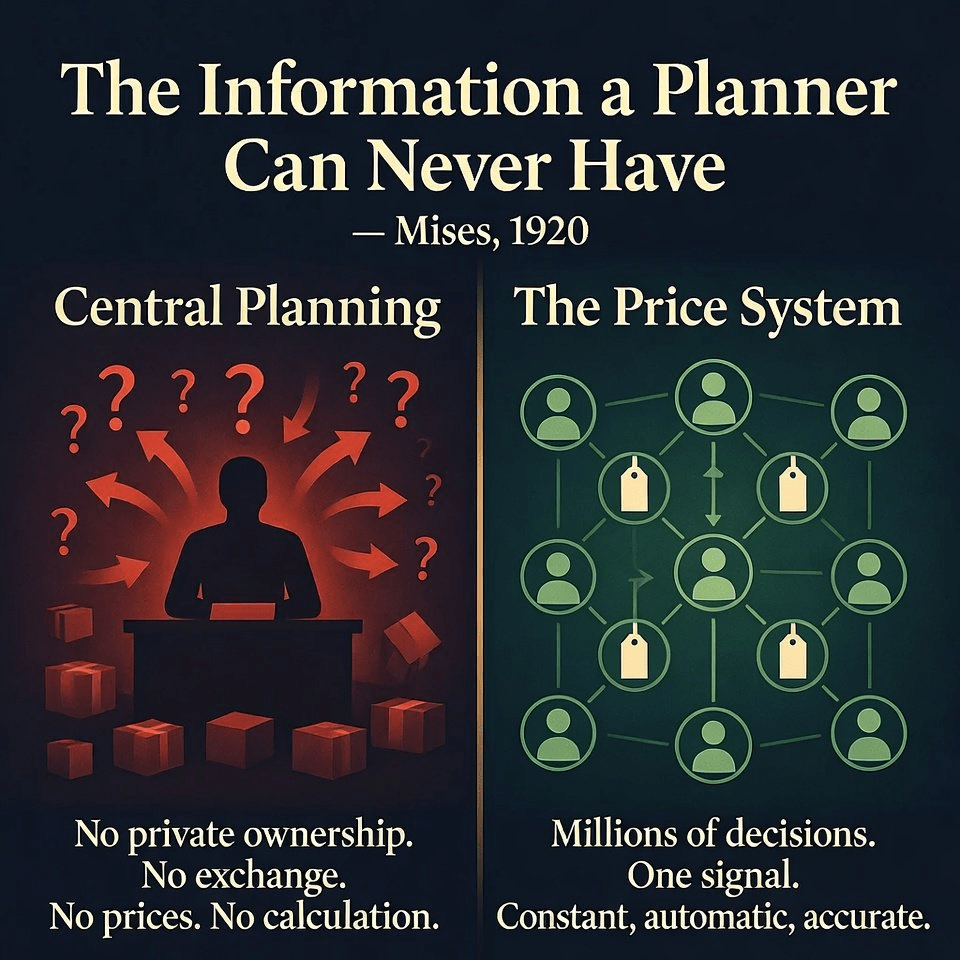
In a market economy, the answer is straightforward. Wood has a price. Steel has a price. Labour has a price. The manager compares costs, weighs the alternatives against what customers will pay for the finished product, and makes the decision that produces a profit. The price system does the calculating. It aggregates the preferences of every buyer and seller of wood and steel and labour across the entire economy into a single number that the manager can use.
Now remove private ownership of the means of production. Wood is no longer bought and sold between competing owners — it is allocated by the planning bureau. Steel is allocated by the planning bureau. There are no market transactions in capital goods, because the state owns all of them. There are no prices for the inputs, because prices require exchange, and exchange requires private property.
Without prices for capital goods, the manager cannot calculate. He cannot determine whether wood or steel is the more economical choice, because “economical” has no meaning without a price relationship connecting inputs to outputs. He can produce chairs. He cannot know whether producing them is worth what it costs, because the cost cannot be expressed in any coherent unit.
Multiply this across an entire economy — millions of goods, billions of input combinations, constantly shifting supply and demand — and the impossibility becomes total. Rational economic planning without market prices is not merely difficult. The information simply does not exist. You cannot calculate with numbers that don’t exist.
Mises put it plainly: “Where there is no market, there is no price system, and where there is no price system, there can be no economic calculation.”
The Attempt at a Rebuttal
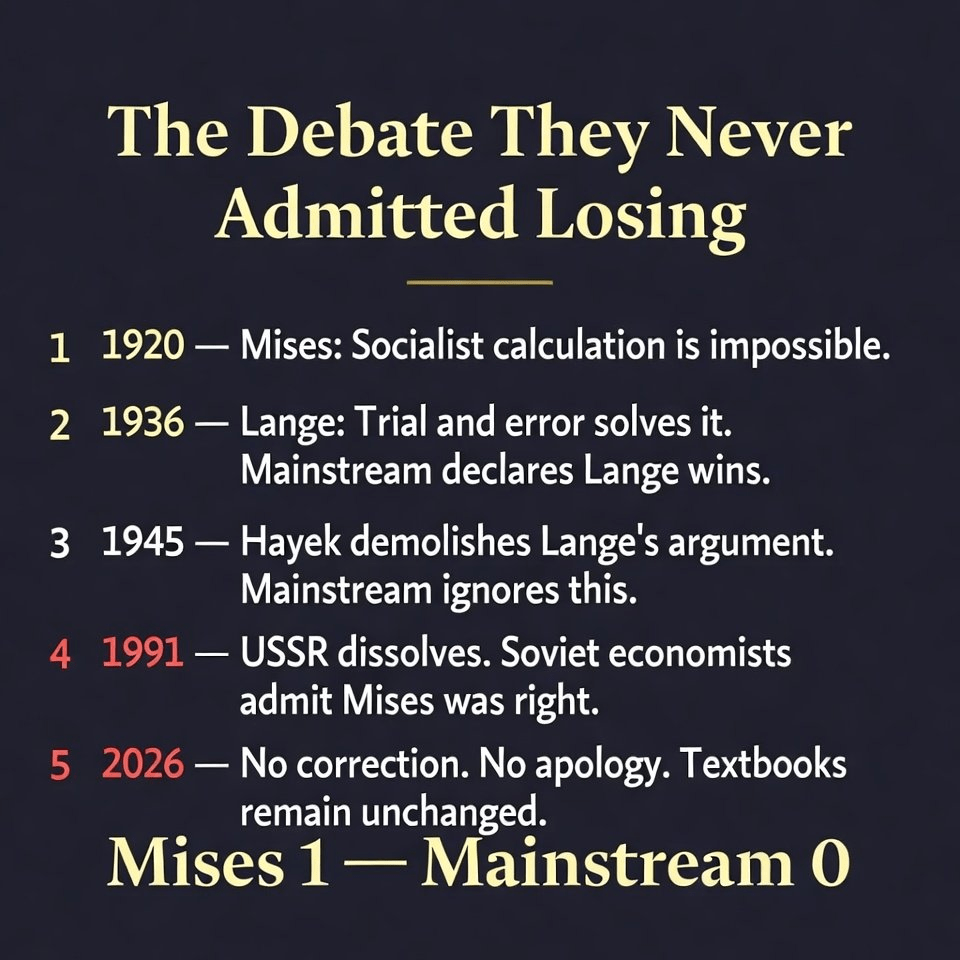
Sixteen years passed. Then, in 1936, Polish economist Oskar Lange published what became the mainstream economics establishment’s official answer to Mises.
Lange opened his paper with elaborate flattery. “Socialists have certainly good reason to be grateful to Professor Mises,” he wrote, “the great advocatus diaboli of their cause. For it was his powerful challenge that forced socialists to recognise the importance of an adequate system of economic accounting.” Then he proceeded to argue that a central planning board could simulate market prices through trial and error — observing shortages and surpluses, adjusting prices until they cleared, and thereby mimicking what markets do spontaneously.
The mainstream economics profession embraced this as a decisive rebuttal. The calculation debate, they declared, was over. Mises had raised a legitimate problem; Lange had solved it.
Hayek dismantled Lange’s response in a series of essays, most devastatingly in “The Use of Knowledge in Society” in 1945. The problem was not finding the right prices through trial and error, Hayek showed — it was that the information needed to set them is not available to any central authority in the first place. The knowledge is dispersed, local, tacit, and constantly changing. The market doesn’t just solve the calculation problem; it is the only mechanism capable of generating the information needed to solve it. No planning board, however sophisticated, can replicate what millions of individual buyers and sellers communicate to each other through price signals every second of every day.
The mainstream economics profession had heard Lange and declared victory. They had not heard Hayek. The USSR pressed ahead.
Lange’s Model, Applied
When Soviet-controlled communism was imposed on Poland after World War II, Oskar Lange returned from his comfortable position at the University of Chicago to help build the new socialist economy. The state planners did not use his trial-and-error model. They used Soviet-style central planning — arbitrary output targets, fixed prices, production quotas handed down from ministries with no feedback mechanism connecting them to actual human needs.
Lange’s theoretical system was never implemented anywhere it was actually supposed to be tested. The gap between what he had proposed in the 1936 paper and what actually happened in every socialist country that tried central planning tells you something important: even the socialists who theoretically defeated Mises couldn’t build what they claimed was possible. They defaulted, every time, to the cruder version — the one Mises had already shown was doomed.
The results were consistent across every country and every decade. Queues for basic goods. Chronic shortages alongside surpluses nobody wanted. Factories producing the wrong things in the wrong quantities. Agricultural sectors that couldn’t feed their own populations. The information that markets generate through prices — and that planning boards cannot generate through any other mechanism — was simply absent, and the absence was catastrophic. The Score, Settled
In 1991 the Soviet Union dissolved. Shortly before it did, Soviet economists and officials began admitting privately — and then publicly — that Mises had been right in 1920. The system had never been able to calculate rationally. Decades of apparent production had been mostly waste. The statistics had been falsified. The shortages had been real.
The mainstream economics profession, which had declared Lange the winner of the debate in the 1930s, did not issue a correction. The textbooks were not updated. The history of the debate was quietly buried. Most economics students today have never heard of it, let alone been taught that one side was definitively, empirically, catastrophically vindicated.
Mises published his proof in 1920 as a relatively young man, working in a government office while socialist revolutionaries tried to seize the streets below his window. The experiment he warned against ran for seventy years across a third of the world’s surface. When it ended, it confirmed everything he had said.
None of the people who ignored him apologised. Most of them are still in charge of economic education.
The calculation problem was only one of Mises’s contributions to economics. Having proved that socialism cannot calculate, he set out to build something far larger — a complete system of economic theory derived from first principles, with no assumptions borrowed from mathematics or historical data. That project, decades in the making, produced the most ambitious work in the history of the discipline.
“Rational economic activity is impossible in a socialist commonwealth.” — Ludwig von Mises, Economic Calculation in the Socialist Commonwealth, 1920
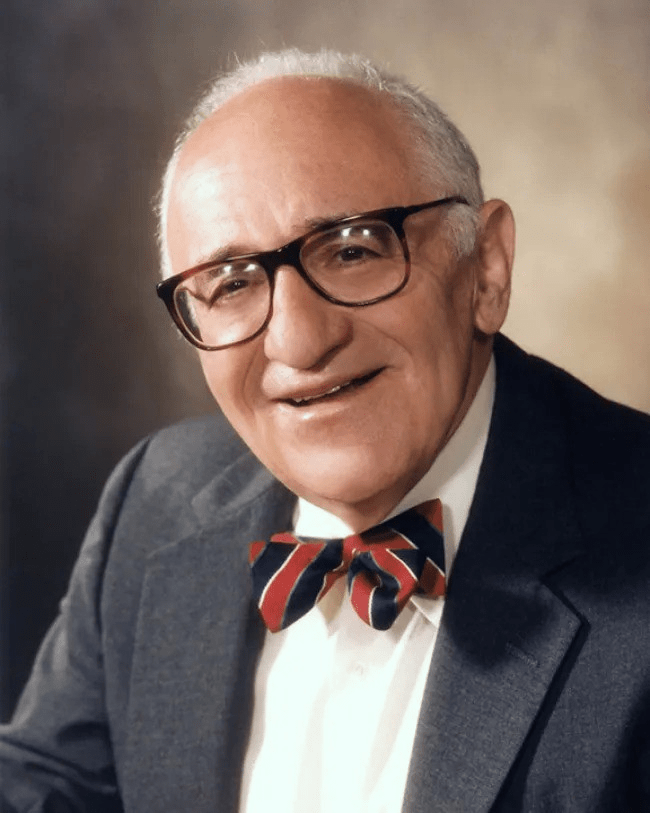
Murray Rothbard gave you the tools to dismantle the state in its own language, and he did it with a smile.
Consider his observation that “the State is a gang of thieves writ large.” Not inflammatory rhetoric: a precise description of an institution that extracts resources through threats of violence, then congratulates itself for providing “services” you never requested. Rothbard stripped the ceremonial robes off government and showed you the mugger underneath.
His insight on taxation cuts equally deep: “There can be no such thing as ‘fairness in taxation.’ Taxation is nothing but organized theft.” You feel the clarity immediately. Every politician who promises a “fairer tax code” is promising to redistribute your property more elegantly.
Rothbard also wrote, “Freedom of speech is meaningless unless it means the freedom of the person who thinks differently.” Civil liberties divorced from economic liberty collapse into performance.
He wrote prolifically from the 1950s until his death in January 1995, building an entire architecture of thought. The man never hedged, and that discipline produced ideas sharp enough to still cut through 2026’s consensus thinking without breaking a sweat.


You must be logged in to post a comment.