Proof the 2020 election was stolen by a cyber attack, nationwide, from the top of the ballot to the bottom. This was a crime against America. This is not about a political party and not only about the presidential election.
I hope some of your were able to tune in for Professor Richard Lindzen’s zoom lecture and Q&A on Wednesday. The sponsors, Clintel Foundation in Dublin, said they will re-record the lecture. If you want the link to the lecture, let me know and I will send you a link when I receive it.
As usual with his lectures, there are many take away quotes. This is one that will be immediately useful:
“Stop treating it [i.e. AGW…human-caused global warming/climate change] as a worthy opponent. Do not ascribe reasonableness to the other side. It is not reasonable, not true, not even plausible.”
~ Richard Lindzen, Professor Emeritus, Alfred P. Sloan Professor of Meteorology, Massachusetts Institute of Technology. (31 March 2021. Zoom call Clintel Foundation)
29 minute lecture
Curriculum Vitae
Richard Siegmund Lindzen
Home: 301 Lake Avenue Newton, MA 02461 (617) 332-4342
October-December l969. Visiting Professor, Department of Environmental Sciences, Tel Aviv University.
l972-l982. Gordon McKay Professor of Dynamic Meteorology, Harvard University.
February-June l975. Visiting Professor of Dynamic Meteorology, Massachusetts Institute of Technology.
January-June l979. Lady Davis Visiting Professor, Department of Meteorology, The Hebrew University, Jerusalem, Israel.
September l980-June l983. Director, Center for Earth and Planetary Physics, Harvard University.
July l982-June l983. Robert P. Burden Professor of Dynamical Meteorology, Harvard University.
July l983- . Alfred P. Sloan Professor of Meteorology, Massachusetts Institute of Technology. (Emeritus status as of 30 June 2013)
June 1988-2009 . Distinguished Visiting Scientist at Jet Propulsion Laboratory.
September 1996- Visiting professor, Laboratory for Dynamic Meteorology, Paris
November 2013- Distinguished Senior Fellow, Cato Institute
July 2013 Retired and assumed Emeritus status
HONORS:
Phi Beta Kappa
Sigma Xi
NCAR Outstanding Publication Award, l967
AMS Meisinger Award, l968
AGU Macelwane Award, l969
Alfred P. Sloan Fellowship, l970-l976
Vikram Amblal Sarabhai Professor at Physical Research Laboratory, Ahmedabad, India, 1985
AMS Charney Award, 1985
Japanese Society for the Promotion of Science Fellowship, Dec. 1986-Jan. 1987
Member, National Academy of Sciences
Fellow, American Academy of Arts & Sciences
Fellow, American Meteorological Society
Fellow, American Geophysical Union
Fellow, American Association for the Advancement of Science
Sackler Visiting Professor, Tel Aviv University, January 1992
Landsdowne Lecturer, University of Victoria, March 1993
Member, Norwegian Academy of Science and Letters
Bernhard Haurwitz Memorial Lecturer, American Meteorological Society, 1997
Leo Prize of the Wallin Foundation (first recipient), 2006
Distinguished Engineering Achievement Award of the Engineers’ Council, February 2009
Petr Beckmann Award of Doctors for Disaster Preparedness, 2012
Member, European Academy of Sciences and Arts.
MEMBERSHIP:
American Meteorological Society (resigned)
National Academy of Sciences
American Academy of Arts and Science
American Association for the Advancement of Science
American Geophysical Union (resigned)
European Geophysical Society
World Institute of Sciences
Norwegian Academy of Science and Letters
European Academy of Sciences and Arts
CO2 Coalition
OTHER:
Corresponding Member, Committee on Human Rights, National Academy of Sciences
Lead author of the 2001 Report of the Intergovernmental Panel on Climate Change
Member, Climate Change Science Program Product Development Advisory Committee of the Department of Energy (term ended in 2009)
Previous service includes serving on editorial board of Dynamics of Atmospheres and Oceans and PAGEOPH, membership on the Rocket Research Committee, the US GARP (Global Atmospheric Research Program) Committee, the Assembly of Mathematical and Physical Sciences, the executive committee of the Space Studies Board, and the executive committee of the Board on Atmospheric Sciences and Climate of the National Research Council, serving as a member of the Woods Hole Oceanographic Institution Corporation and serving on the council of the American Meteorological Society, Atmospheric Dynamics Committee of the AMS, MIT representative to UCAR, Distinguished Visiting Scientist at the Jet Propulsion Laboratory and consultant to the Goddard Space Flight Center..
CURRENT RESEARCH INTERESTS:
The general circulation of the earth’s atmosphere.
Climate dynamics.
Hydrodynamic shear instability.
Dynamics of the middle atmosphere.
Dynamics of planetary atmospheres.
Parameterization of cumulus convection.
Tropical meteorology.
Climate sensitivity.
Role of cirrus in climate.
MIT ACTIVITIES
Former Faculty Advisor, MIT Radio Society
Former Member, Board of MIT Hillel Foundation
Ph. D. THESIS STUDENTS
Donna Blake, Siu-Shung Hong, John Boyd, Lloyd Shapiro, Edwin Schneider, Margaret Niehaus, Jeffrey Forbes, Duane Stevens, Ian Watterson, Arthur Hou, Brian Farrell, Petros Ioannou, Arthur Rosenthal, Ka-Kit Tung, David Jacqmin, Ronald Miller, Arlindo DaSilva, Christopher Snyder, De-Zheng Sun, Daniel Kirk-Davidoff, Constantine Giannitsis, Gerard Roe, Nili Harnik, Pablo Zurita-Gotor, Roberto Rondanelli
M.S. THESIS STUDENTS
Joseph Chang, Niu Yang, Wen-Wei Pan
POST-DOCTORAL FELLOWS
Stephen Fels, Edward Sarachik, Ching-Yen Tsay, Isaac Held, Pinhas Alpert, M. Uryu, Steven Ashe, T. Aso, Randall Dole, Edwin Schneider, David Neelin, John Barker, Y.-Y. Hayashi, Michael Fox-Rabinowitz, Yuri Chernyak, Hans Schneider, Sumant Nigam, Edmund Chang, Myles Allen, Zachary Guralnik, Yong-Sang Choi, Heeje Ho.
PUBLICATIONS (excluding numerous op-eds)
1. (1965) On the asymmetric diurnal tide. Pure & Appl. Geophys., 62, 142-147.
2. R.S. Lindzen and R.M. Goody (1965). Radiative and photochemical processes in mesospheric dynamics: Part I. Models for radiative and photochemical processes. J. Atmos. Sci., 22, 341-348.
3. (1965) The radiative-photochemical response of the mesosphere to fluctuations in radiation. J. Atmos. Sci., 22, 469-478.
4. (1966) Radiative and photochemical processes in mesospheric dynamics: Part II. Vertical propagation of long period disturbances at the equator. J. Atmos. Sci., 23, 334-343.
5. (1966) Radiative and photochemical processes in mesospheric dynamics. Part III. Stability of a zonal vortex at midlatitudes to axially symmetric disturbances. J. Atmos. Sci., 23, 344-349.
6. (1966) Radiative and photochemical processes in mesospheric dynamics. Part IV. Stability of a zonal vortex at midlatitudes to baroclinic waves. J. Atmos. Sci., 23, 350-359.
7. (1966) On the theory of the diurnal tide. Mon. Wea. Rev., 94, 295-301.
8. (1966) Crude estimate for the zonal velocity associated with the diurnal temperature oscillation in the thermosphere. J. Geophys. Res., 71, 865-870.
9. (1966) On the relation of wave behavior to source strength and distribution in a propagating medium. J. Atmos. Sci., 23, 630-632.
19. (1968) The application of classical atmospheric tidal theory. Proc. Roy. Soc., A, 303, 299-316.
20. (1968) Lower atmospheric energy sources for the upper atmosphere. Met. Mono., 9, 37-46.
21. (1968) Rossby waves with negative equivalent depths — comments on a note by G.A. Corby. Q.J. Roy. Met. Soc., 94, 402-407.
22. R.S. Lindzen, E.S. Batten and J.W. Kim (1968). Oscillations in atmospheres with tops. Mon. Wea. Rev., 96, 133-140.
23. R.S. Lindzen and J.R. Holton (1968). A note on Kelvin waves in the atmosphere. Mon. Wea. Rev., 96, 385-386.
24. R.S. Lindzen and T. Matsuno (1968). On the nature of large scale wave disturbances in the equatorial lower stratosphere. J. Met. Soc. Japan, 46, 215-221.
25. R.S. Lindzen and J.R. Holton (1968). A theory of quasi-biennial oscillation. J. Atmos. Sci., 26, 1095-1107.
26. (1968) Vertically propagating waves in an atmosphere with Newtonian cooling inversely proportional to density. Can. J. Phys., 46, 1835-1840.
27. (1968) Some speculations on the roles of critical level interactions between internal gravity waves and mean flows. In Acoustic Gravity Waves in the Atmosphere, T.M. Georges, ed. U.S. Government Printing Office.
28. (1969) Data necessary for the detection and description of tides and gravity waves in the upper atmosphere. J. Atmos. Ter. Phys., 31, 449-456.
29. R.S. Lindzen and S. Chapman (1969). Atmospheric tides. Sp. Sci. Revs., 10, 3-188.
30. R.S. Lindzen and H.L. Kuo (1969). A reliable method for the numerical integration of a large class of ordinary and partial differential equations. Mon. Wea. Rev., 97, 732-734.
31. (1969) Vertical momentum transport by large scale disturbances of the equatorial lower stratosphere. J. Met. Soc. Japan., 48, 81-83.
32. (1969) The latke, the hamantasch and the (m)oral crisis in the university. The Jewish Digest, 15, 55-58.
33. S. Chapman and R.S. Lindzen (1970). Atmospheric Tides, D. Reidel Press, Dordrecht, Holland, 200 pp.
34. (1970) Internal equatorial planetary scale waves in shear flow. J. Atmos. Sci., 27, 394-407.
35. (1970) The application and applicability of terrestrial atmospheric tidal theory to Venus and Mars. J. Atmos. Sci., 27, 536-549.
36. (1970) Mean heating of the thermosphere by tides. J. Geophys. Res., 75, 6868-6871.
37. (l970) Internal gravity waves in atmospheres with realistic dissipation and temperature: Part I. Mathematical development and propagation of waves into the thermosphere. Geophys. Fl. Dyn., 1, 303-355.
38. R.S. Lindzen and D. Blake (1971). Internal gravity waves in atmospheres with realistic dissipation and temperature: Part II. Thermal tides excited below the mesopause. Geophys. Fl. Dyn., 2, 31-61.
39. (1971) Internal gravity waves in atmospheres with realistic dissipation and temperature: Part III. Daily variations in the thermosphere. Geophys. Fl. Dyn., 2, 89-121.
40. (197l) Tides and gravity waves in the upper atmosphere. In Mesospheric Models and Related Experiments, G. Fiocco, ed., D. Reidel Pub., Dordrecht, Holland.
41. (1971) Atmospheric Tides. Lec. in App. Math., 14, 293-362.
42. (1971) Some aspects of atmospheric waves in realistic atmosphere. In Atmospheric Model Criteria, R.E. Smith and S.T. Wu, eds., Marshall Space Flight Center, NASA Report SP-305, pp. 71-90.
43. (1971) Equatorial planetary waves in shear: Part I. J. Atmos. Sci., 28, 609-622.
44. (1972) Equatorial planetary waves in shear: Part II. J. Atmos. Sci., 29, 1452-1463.
45. (1972) Atmospheric tides. In Structure and Dynamics of the Upper Atmosphere, F. Verniani, ed., Elsevier, New York, pp. 21-88.
46. R.S. Lindzen and D. Blake (1972). Lamb waves in the presence of realistic distributions of temperature and dissipation. J. Geophys. Res., 7, 2166-2176.
47. (1972) The 26 month oscillation in the atmosphere. In Geopaedia Encyclopedic Dictionary of Geosciences, Pergamon Press, New York.
48. (1972) Atmospheric tides. In Geopaedia Encyclopedic Dictionary of Geosciences, Pergamon Press, New York.
49. J.R. Holton and R.S. Lindzen (1972). An updated theory for the quasibiennial cycle of the tropical stratosphere. J. Atmos. Sci., 29, 1076-1080.
50. (1973) Wave-mean flow interaction in the upper atmosphere. Bound. Lay. Met., 4, 327-343.
52. D. Blake and R.S. Lindzen (1973). Effect of photochemical models on calculated equilibria and cooling rates in the stratosphere. Mon. Wea. Rev., 101, 738-802.
54. R.S. Lindzen and S.S. Hong (1973). Equivalent gravity modes — an interim evaluation. Geophys. Fl. Dyn., 4, 279-292.
55. R.S. Lindzen and D. Will (1973). An analytic formula for heating due to ozone absorption. J. Atmos. Sci., 30, 513-515.
56. (1974) Wave-CISK and tropical meteorology. Proceedings Int’l. Trop. Met. Meeting, 1/31-2/7, Nairobi, Kenya. Amer. Met. Soc. Pub.
57. (1974) Wave-CISK in the tropics. J. Atmos. Sci., 31, 156-179.
58. (1974) Wave-CISK and tropical spectra. J. Atmos. Sci., 31, 1447-1449.
59. (1974) Stability of a Helmholtz velocity profile in a continuously stratified infinite Boussinesq fluid – applications to a clear air turbulence. J. Atmos. Sci., 31, 1507-1514.
60. S. Fels and R.S. Lindzen (1974). Interaction of thermally excited gravity waves with mean flows. Geophys. Fl. Dyn., 6, 149-191.
61. R.S. Lindzen and S.S. Hong (1974). Effects of mean winds and horizonal temperature gradients on solar and lunar semidiurnal tides in the atmosphere. J. Atmos. Sci., 31, 1421-1446.
62. (1975) Reply to comments by A. Hollingsworth. J. Atmos. Sci., 31, 1643.
63. R.S. Lindzen and C.Y. Tsay (1975). Wave structure of tropical atmosphere over the Marshall Islands during 1 April – 1 July 1958. J. Atmos. Sci., 32, 2009-2021.
64. (1976) Reply to comments by M. Geller. J. Atmos. Sci., 33, 558.
65. (1976) A modal decomposition of the semidiurnal tide in the lower atmosphere. J. Geophys. Res., 81, 2923-2925.
66. R.S. Lindzen and S.S. Hong (1976). Solar semidiurnal tide in the thermosphere. J. Atmos. Sci., 33, 135-153.
67. R.S. Lindzen and A.J. Rosenthal (1976). On the instability of Helmholtz velocity profiles in stably stratified fluids when a lower boundary is present. J. Geophys. Res., 81, 1561-1571.
68. R.S. Lindzen and K.K. Tung (1976). Banded convective activity and ducted gravity waves. Mon. Wea. Rev., 104, 1602-1617.
69. E. Schneider and R.S. Lindzen (1976). A discussion of the parameterization of momentum exchange by cumulus convection. J. Geophys. Res., 81, 3158-3160.
70. E. Schneider and R.S. Lindzen (1976). On the influence of stable stratification on the thermally driven tropical boundary layer. J. Atmos. Sci., 33, 1301-1307.
71. J. Forbes and R.S. Lindzen (1976). Atmospheric solar tides and their electrodynamic effects. Part I: The global Sq current system. J. Atmos. Ter. Phys., 38, 897-910.
72. J. Forbes and R.S. Lindzen (1976). Atmospheric solar tides and their electrodynamic effects. Part II: The equatorial electrojet. J. Atmos. Ter. Phys., 38, 911-920.
73. J. Forbes and R.S. Lindzen (1977). Atmospheric solar tides and their electrodynamic effects. Part III: The polarization electric field. J. Atmos. Ter. Phys., 38, 1369-1377.
74. (1977) Some aspects of convection in meteorology. In Problems of Stellar Convection, J.P. Zahn, ed., Springer Verlag, New York, 128-141.
75. R.S. Lindzen and B. Farrell (1977). Some realistic modifications of simple climate models. J. Atmos. Sci., 34, 1487-1501.
76. R.S. Lindzen, J. Forbes and S.S. Hong (1977). Semidiurnal Hough modes extensions and their application. Naval Research Lab. Memorandum. Rep. 3442, 65 pp.
77. E. Schneider and R.S. Lindzen (1977). Axially symmetric steady state models of the basic state of instability and climate studies. Part I: Linearized calculations. J. Atmos. Sci., 34, 253-279.
78. D. Stevens, R.S. Lindzen and L. Shapiro (1977). A new model of tropical waves incorporating momentum mixing by cumulus convection. Dyn. Atmos. and Oc., 1, 365-425.
79. (1978) Effect of daily variations of cumulonimbus activity on the atmospheric semidiurnal tide. Mon. Wea. Rev., 106, 526-533.
81. R.S. Lindzen and K.K. Tung (1978). Wave overreflection and shear instability. J. Atmos. Sci., 35, 1626-1632.
82. D. Stevens and R.S. Lindzen (1978). Tropical wave-CISK with a moisture budget and cumulus friction. J. Atmos. Sci., 35, 940-961.
83. D. Stevens and R.S. Lindzen (1978). Tropical wave-CISK with cumulus friction. Proc. AMS Symp. on Trop. Met., Key Biscayne.
84. R.S. Lindzen and J.M. Forbes (l978). Boundary layers associated with thermal forced planetary waves. J. Atmos. Sci., 35, 1441-1449.
85. K.K. Tung and R.S. Lindzen (1979). Theory of stationary long waves. Part I. A simple theory of blocking. Mon. Wea. Rev., 107, 714-734.
86. K.K. Tung and R.S. Lindzen (1979). Theory of stationary long waves. Part II. Resonant Rossby waves in the presence of realistic vertical shear. Mon. Wea. Rev.107, 735-750.
87. (1979) On a calculation of the symmetric circulation and its implications for the role of eddies. Proceedings of the NCAR General Circulation Colloquium, 1978.
88. (1979) The concept of wave overreflection and its application to baroclinic instability. Proceedings of the NCAR General Circulation Colloquium 1978.
89. R.S. Lindzen, B. Farrell and K.K. Tung (1980). The concept of wave overreflection and its application to baroclinic instability. J. Atmos. Sci., 37, 44-63.
90. R.S. Lindzen and B. Farrell (1980). Reply. J. Atmos. Sci., 37, 900-902.
91. R.S. Lindzen and B. Farrell (1980). A simple approximate result for the maximum growth rate of baroclinic instabilities. J. Atmos. Sci., 37, 1648-1654.
92. R.S. Lindzen and B. Farrell (1980). The role of polar regions in global climate, and the parameterization of global heat transport. Mon. Wea. Rev., 108, 2064-2079.
93. (1980) Theory of atmospheric tides. J. Meteor. Soc. Japan, 58, 273-278.
94. (1980) Wave-CISK and cumulus parameterization in perspective. Proceedings of NAS Symposium on the Impact of GATE on Large-Scale Numerical Modeling of the Atmosphere and Ocean. Woods Hole, MA.
95. E.K. Schneider and R.S. Lindzen (1980). Comments on cumulus friction: Estimated influence on the tropical mean meridional circulation. J. Atmos. Sci., 37, 2803-2806.
96. R.S. Lindzen and A.J. Rosenthal (1981). A WKB asymptotic analysis of baroclinic instability. J. Atmos. Sci., 38, 619-629.
97. (1981) Turbulence and stress due to gravity wave and tidal breakdown. J. Geophys. Res., 86, 9707-9714.
98. (1981) Some remarks on cumulus parameterization. Proceedings of the NASA Clouds in Climate Conference, NASA Report, available NASA/Goddard Institute of Space Studies.
99. R.S. Lindzen, A.Y. Hou and B.F. Farrell (1982). The role of convective model choice in calculating the climate impact of doubling CO2. J. Atmos. Sci., 39, 1189-1205.
100. R.S. Lindzen, B.F. Farrell and D. Jacqmin (1982). Vacillations due to wave interference. J. Atmos. Sci., 39, 14-23.
101. R.S. Lindzen and M.R. Schoeberl (1982). A note on the limits of Rossby wave amplitudes. J. Atmos. Sci., 39, 1171-1174.
102. R.S. Lindzen, T. Aso and D. Jacqmin (1982). Linearized calculations of stationary waves in the atmosphere. J. Met. Soc. Japan, 60, 66-78.
103. R.S. Lindzen and J. Forbes (1982). Turbulence originating from stable internal waves. J. Geophys. Res., 88, 6549-6553.
104. R.S. Lindzen, B. Farrell and A.J. Rosenthal (1982). Absolute barotropic instability and monsoon depressions. J. Atmos. Sci., 40, 1178-1184.
105. A. Rosenthal and R.S. Lindzen (1983). Instabilities in a stratified flud having one critical level. Part I: Results. J. Atmos. Sci., 40, 509-520.
106. A. Rosenthal and R.S. Lindzen (1983). Instabilities in a stratified fluid having one critical level. Part II: Explanation of gravity wave instabilities as overreflected waves. J. Atmos. Sci., 40, 521-529.
107. A. Rosenthal and R.S. Lindzen (1983). Instabilities in a stratified fluid having one critical level. Part III: Kelvin-Helmholtz instabilities as overreflected waves. J. Atmos. Sci., 40, 530-542.
108. A. Rosenthal and R.S. Lindzen (1983). Instabilities in a stratified shear flow in the absence of Kelvin-Helmholtz instabilities. Tech. Rept., Center for Met. and Phys. Oceanogr., MIT.
109. R.S. Lindzen, A.J. Rosenthal and B. Farrell (1983). Charney’s problem for baroclinic instability applied to barotropic instability. J. Atmos. Sci., 40, 1029-1034.
110. R.S. Lindzen, D. Straus and B. Katz (1984). An observational study of large scale atmospheric Rossby waves. J. Atmos. Sci., 41, 1320-1335.
111. (1984) Gravity waves in the mesosphere, in Dynamics of the Middle Atmosphere, J.R. Holton and T. Matsuno, eds., Terra Scientific Publishing Company, Tokyo, Japan.
112. R.S. Lindzen and H. Teitelbaum (1984). Venus zonal wind above the cloud layer. ICARUS, 57, 356-361.
113. (1984) Charney’s work on vertically propagating Rossby waves — with remarks on his early research at MIT, in The Atmosphere – A Challenge, A memorial to Jule Charney, R.S. Lindzen, E.N. Lorenz, and G.W. Platzman, editors, Historical Monograph Series of the Am. Meteor. Soc. appeared in 1990.
114. M. Schoeberl and R.S. Lindzen (1984). A numerical simulation of barotropic instability including wave-mean flow interaction. J. Atmos. Sci., 41, 1368-1379.
115. R.S. Lindzen and J. Barker (1985). Instability and wave over-reflection in stably stratified shear flow. J. Fluid Mech., 151, 189-217.
116. D. Jacqmin and R.S. Lindzen (1985). The causation and sensitivity of the northern winter planetary waves. J. Atmos. Sci., 42, 724-745.
119. (1986). A simple model for 100 thousand years oscillations in glaciation. J. Atmos. Sci., 43, 986-996.
120. R.S. Lindzen and S. Rambaldi (1986). A study of overreflection in viscous Poiseuille flow. J. Fluid Mech., 165, 355-372.
121. P. Ioannou and R.S. Lindzen (1986). Baroclinic instability in the presence of barotropic jets. J. Atmos. Sci., 43, 2999-3014.
122. R.S. Lindzen and S. Nigam (1987). On the role of sea surface temperature gradients in forcing low level winds and convergence in the tropics. J. Atmos. Sci., 44, 2418-2436.
123. D.M. Straus, R.S. Lindzen and A.M. da Silva (1987). The characteristic Rossby frequency. J. Atmos. Sci., 44, 1100-1105.
124. (1987) The development of the theory of the QBO. (Personal Recollections). Bull. Am. Met. Soc., 68, 329-337.
125. R.S. Lindzen and B. Farrell (1987). Atmospheric Dynamics. Rev. of Geophys., 25, 323-328.
126. A.M. da Silva and R.S. Lindzen (1988). A mechanism for the excitation of ultralong Rossby waves, J. Atmos. Sci., 44, 3625-3639.
127. (1988) CO2 feedbacks and the 100K year cycle. Meteorol. Atmos. Phys., 38, 42-49.
128. (1988) Instability of plane parallel shear flow (Towards a mechanistic picture of how it works). PAGEOPH, 16, 103-121.
129. (1988) Some remarks on cumulus parameterization. PAGEOPH, 16, 123-135.
130. (1988) Supersaturation of vertically propagating internal gravity waves. J. Atmos. Sci., 45, 705-711.
131. R.S. Lindzen and A.Y. Hou (1988). Hadley circulations for zonally averaged heating centered off the equator. J. Atmos. Sci., 45, 2416-2427.
132. R.S. Lindzen and K.-K.- Tung (1988). Comments on ‘On the shear instability without over-reflection’ by Masaaki Takahashi. J. Met. Soc. Japan, 66, 179-184.
133. R. Miller and R.S. Lindzen (1988). Viscous destabilization of stratified shear flow for Ri>1/4. Geophys. Astrophys. Fl. Dyn., 42, 49-91.
134. C. Snyder and R.S. Lindzen (1988). Upper level baroclinic instability. J. Atmos. Sci., 45, 2446-2459.
135. S. Nigam and R.S. Lindzen (1989). The Sensitivity of stationary waves to variations in the basic state zonal flow. J. Atmos. Sci., 46, 1746-1768.
136. R.S. Lindzen and M. Fox-Rabinovitz (1989). Consistent horizontal and vertical resolution. Mon. Wea. Rev., 117, 2575-2583.
137. P. Ioannou and R.S. Lindzen (1990). W.K.B.J. approximation of the stability of a frontal mean state. J. Atmos. Sci., 47, 2825-2831.
138. (1990) Some coolness concerning global warming. Bull. Amer. Met. Soc., 71, 288-299.
139. (1990) Some remarks on global warming. Env. Sci. Tech., 24, 424-427.
140. (1990) A skeptic speaks out. EPA Jour., 16, 46-47.
141. (1990) Greenhouse warming: science v. consensus. in Environmental Consequences of Energy Production, proceedings of the seventeenth annual Illinois Energy Conference. Publ. by Energy Resources Center, The University of Illinois at Chicago.
142. (1990) Dynamics in Atmospheric Physics, Cambridge University Press, New York, 310pp.
143. (edited with G.W. Platzman and E.N. Lorenz) (1990) The Atmosphere – A Challenge A memorial to Jule Charney, Historical Monograph Series of the Am. Meteor. Soc.
144. (1990) Response: Greenhouse warming and the tropical water budget. Bull. Amer. Met. Soc., 71, 1465-1467.
145. C. Snyder and R.S. Lindzen (1991). Quasi-geostrophic wave-CISK in an unbounded baroclinic shear. J. Atmos. Sci., 48, 78-88.
146. (with Volkmar Wirth) (1991) Zero potential vorticity gradient basic states in the neighborhood of the equator. in Proceedings of the Fourteenth Annual Climate Diagnostics Workshop. NTIS, US Dept. of Commerce, Springfield, VA pp 256-259.
147. (1991) Some remarks on the dynamics of the Jovian atmospheres. Geophys. and Astrophys. Fl. Dyn., 58, 123-141.
148. (1991) Prospects for tropical modeling. Proc. ECMWF Conf. on Tropical Meteorology.
149. (1991) The Hadley circulation. Proc. ECMWF Conf. on Tropical Meteorology.
150. (1991) Some uncertainties with respect to water vapor’s role in climate sensitivity. Proceedings of NASA Workshop on the Role of Water Vapor in Climate Processes, October 29 – November 1, 1990 in Easton, Maryland (D.O’C. Starr and H. Melfi, editors).
151. Miller, R. and R.S. Lindzen (1992) Organization of rainfall by an unstable jet with application to African waves. J. Atmos. Sci., 49, 1523-1540.
152. Hou, A.Y. and R.S. Lindzen (1992) The influence of concentrated heating on the Hadley circulation. J. Atmos. Sci., 49, 1233-1241.
153. (1992) Global warming: the origin and nature of the alleged scientific consensus. Regulation, Spring 1992 issue, 87-98.
154. A.M. Da Silva and R.S. Lindzen (1993) On the establishment of stationary waves in the northern hemisphere winter. J. Atmos. Sci., 50, 43-61.
155. Fox-Rabinovitz, M. and R.S. Lindzen (1993) Numerical experiments on consistent horizontal and vertical resolution for atmospheric models and observing systems. Mon. Wea. Rev., 121, 264–271.
156. Sun, D-Z. and R.S. Lindzen (1993) Water vapor feedback and the ice age snowline record. Ann. Geophys., 11, 204-215.
157. Sun, D-Z. and R.S. Lindzen (1993) Distribution of tropical tropospheric water vapor. J. Atmos. Sci., 50, 1643-1660.
158. (1993) Baroclinic neutrality and the tropopause. J. Atmos. Sci., 50, 1148-1151.
159. Ioannou, P. and R.S. Lindzen (1993) Gravitational tides on the outer planets; Part I: Formulation for deep planets. Astrophys. J., 406, 252-265.
160. Ioannou, P. and R.S. Lindzen (1993) Gravitational tides on the outer planets; Part II: Application to tidal dissipation on Jupiter. Astrophys. J., 406, 266-278.
161. (1993) On the scientific basis for global warming scenarios. Env. Pollution, 83, 125-134.
162. (1995) Constraining possibilities versus signal detection. pp 182-186 in Natural Climate Variability on Decade-to-Century Time Scales, Ed. D.G. Martinson, National Academy Press, Washington, DC, 630pp.
163. (1993) Commentary (on the benefit of CO2 emission reductions vis a vis climate). in Enhancing Environmental Quality Through Economic Growth, American Council for Capital Formation, Washington, DC, 130-137.
164. (1993) Absence of scientific basis (for global warming scenarios). Exploration and Research (published by National Geographic), 9, 191-200.
166. (1993) Climate dynamics and global change. Ann. Rev. Fl. Mech., 26, 353-378.
167. (1993) Gravity wave breaking: legitimizing popular “fudges”. Current Contents, 24, 8.
168. Sun, D.-Z. and R.S. Lindzen (1994) A PV view of the zonal mean distribution of temperature and wind in the extra-tropical troposphere. J. Atmos. Sci., 51, 757-772.
169. Ioannou, P. and R.S. Lindzen (1994) Gravitiational tides on Jupiter: Part III: Atmospheric response and mean flow acceleration. Astrophys. J., 424, 1005-1013.
170. (1994) The Eady Problem with zero PV gradient but beta unequal to zero. J. Atmos. Sci., 51, 3221-3226.
171. Lindzen, R.S., and W. Pan (1994) A note on orbital control of equator-pole heat fluxes. Clim. Dyn., 10, 49-57.
172. (1994) The effect of concentrated PV gradients on stationary waves. J. Atmos. Sci., 51, 3455-3466.
173. Kirk-Davidoff, D. and R.S. Lindzen (1994) Meridional heat fluxes inferred from past climates and implications for the tropical heat budget. in preparation.
174. Lindzen, R.S., B. Kirtman, D. Kirk-Davidoff and E. Schneider (1994) Seasonal surrogate for climate. J. Climate, 8, 1681-1684.
175. Lindzen, R.S., D.-Z. Sun, E. K.-M. Chang, and P. Ioannou (1994) Properties of a troposphere with zero EPV gradients on isentropes.Proceedings of the Eighteenth Annual Climate Diagnostics Workshop. NTIS, US Dept. of Commerce, Springfield, VA.
176. (1994) What we know and what we don’t know about global warming. pp 335-358 in International Seminar on Nuclear War and Planetary Emergencies – 18th Session – 1993, K. Goebel, editor, World Scientific, Singapore, 444pp.
177. (1994) Classic problems in dynamics revisited. pp 90-98 in The Life Cycles of Extratropical Cyclones, Volume 1 (Grønås, S. and M. Shapiro, Editors), Geophysical Institute, University of Bergen, Bergen, Norway 286 p.
178. (1996) The importance and nature of the water vapor budget in nature and models. In Climate Sensitivity to Radiative Perturbations: Physical Mechanisms and their Validation, H. Le Treut (editor), pp. 51-66, NATO ASI Series 1: Global Environmental Change, Vol. 34, Springer-Verlag, Heidelberg, 331p.
179. (1995) How cold would we get under CO2-less sky? Phys. Today, 48, 78-80.
180. (1996) Science and politics: global warming and eugenics. in Risks, Costs, and Lives Saved, R. Hahn, editor, Oxford University Press, New York, 267pp (Chapter 5, 85-103)
181. (1997) Can increasing atmospheric CO2 affect global climate? Proc. Natl..Acad. Sci. USA, 94, 8335-8342.
182. G.H. Roe and R.S. Lindzen (1996) Baroclinic adjustment in a two-level model with barotropic shear. J. Atmos. Sci., 53, 2749-2754.
183. N. Harnik and R.S. Lindzen (1998) Baroclinic instability in unbounded atmospheres with realistic distributions of PV gradient. J. Atmos. Sci., 55, 344-360.
184. R.S. Lindzen and C. Giannitsis (1998) On the climatic implications of volcanic cooling. J. Geophys. Res., 103, 5929-5941.
185. E. Schneider, R.S. Lindzen, and B. Kirtman (1997) A tropical influence on global climate. J. Atmos. Sci., 54, pp. 1349-1358.
186. D. Braswell and R.S. Lindzen (1998) Anomalous solar absorption and the diurnal atmospheric tide. Geophys. Res. Ltrs., 25, 1293-1296.
187. R.S. Lindzen and G.H. Roe (1997) Correction: The effect of concentrated PV gradients on stationary waves. J. Atmos. Sci., 54, 1815-1818.
188. Giannitsis, C. and R.S. Lindzen (2001) Non-linear saturation of topographically forced Rossby waves in a barotropic model. J. Atmos. Sci., 58, 2927-2941.
189. Schneider, E.K., B.P. Kirtman and R.S. Lindzen (1999) Upper tropospheric water vapor and climate sensitivity. J. Atmos. Sci.,56, 1649-1658.
190. Kirk-Davidoff, D.B. and R.S. Lindzen (2000) An energy balance model based on potential vorticity homogenization. J. Climate, 13, 431-448..
191. (1998) Den Problematiska växthuseffekten. Chapter 8 in Klimatpolitik efter Kyotomötet (T.R. Gerholm, editor), SNS Förlag, Stockholm, 175pp.
192. (1999) The Greenhouse Effect and its problems. Chapter 8 in Climate Policy After Kyoto (T.R. Gerholm, editor), Multi-Science Publishing Co., Brentwood, UK, 170pp.
193. A. Solomon and R.S. Lindzen (2000) The impact of resolution on a numerical simulation of barotropic instability. J. Atmos. Sci., 57, 3799-3816.
194. D. Straus and R.S. Lindzen (2000) Planetary scale baroclinic instability and the MJO. J. Atmos. Sci., 57, 3609-3626.
195. R.S. Lindzen, M.-D. Chou, and A.Y. Hou (2001) Does the Earth have an adaptive infrared iris? Bull. Amer. Met. Soc.82, 417-432.
196. G. Roe and R.S. Lindzen (2001) A one-dimensional model for the interaction between ice sheets and atmospheric stationary waves. Climate Dyn., 17, 479-487.
197. G. Roe and R.S. Lindzen (2001) The mutual interaction between continental-scale ice sheets and atmospheric stationary waves. J. Climate, 14, 1450-1465.
198. R.S. Lindzen and K. Emanuel (2002) The greenhouse effect. in Encyclopedia of Global Change, Environmental Change and Human Society, Volume 1, Andrew S. Goudie, editor in chief, pp 562-566, Oxford University Press, New York,710 pp.
199. Sun, D.-Z., C. Covey, and R.S. Lindzen (2001) Vertical correlations of water vapor in GCMs.. Geophys. Res. Lett., 28 , 259-262.
200. Zurita, P. and R.S. Lindzen (2001) The equilibration of short Charney waves: Implications for potential vorticity homogenization in the extratropical troposphere. J. Atmos. Sci., 58, 3443-3462.
201. Harnik, N. and R.S. Lindzen (2001) The effect of reflecting surfaces on the vertical structure and variability of stratospheric planetary waves. J. Atmos. Sci., 58, 2872-2894.
202. Lindzen, R.S. and C. Giannitsis (2002) Reconciling observations of global temperature change. Geophys. Res. Ltrs.29, (26 June) 10.1029/2001GL014074
203. Lindzen, R.S. (2002a) Do Deep Ocean Temperature Records Verify Models? Geophys. Res. Ltrs., 29, 10.1029/2001GL014360.
204. Lindzen, R.S. (2002b) Richard J. Reed and Atmospheric Tides in A Half Century of Progress in Meteorology: A Tribute to Richard J. Reed, R. Johnson, editor, American Meteorological Society Monograph
205. Chou, M.-D., R.S. Lindzen, and A.Y. Hou (2002a) Impact of Albedo Contrast between Cirrus and Boundary-Layer Clouds on Climate Sensitivity. Atmospheric Chemistry and Physics, 2, 99-101.
206. Lindzen, R.S., M.-D. Chou, and A.Y. Hou (2002) Comments on “No evidence for iris.” Bull. Amer. Met. Soc., 83, 1345–1348
207. Chou, M.-D., R.S. Lindzen, and A.Y. Hou (2002b) Comments on “The Iris hypothesis: A negative or positive cloud feedback?” J. Climate, 15, 2713-2715.
208. Bell, T. L., M.-D. Chou, R.S. Lindzen, and A.Y. Hou (2002) Response to Comment on “Does the Earth Have an Adaptive Infrared Iris?” Bull. Amer. Met. Soc., 83, 598-600.
210. Chou, M.-D. and R.S. Lindzen (2002) Comments on “Tropical convection and the energy balance of the top of the atmosphere.” J. Climate, 15, 2566-2570.
211. Zurita-Gotor, P., and R.S. Lindzen (2004) Baroclinic equilibration and the maintenance of the momentum balance. Part I: barotropic analog. J. Atmos. Sci., 61, 1469-1482.
212. Zurita-Gotor, P., and R.S. Lindzen (2004) Baroclinic equilibration and the maintenance of the momentum balance. Part II: 3-D results. J. Atmos. Sci., 61, 1483-1499.
213. Giannitsis, C. and R.S. Lindzen (2009) Non-linear saturation of vertically propagating Rossby waves. J. Atmos. Sci., 66, 915-934
214. Lindzen, R.S. (2003) The Interaction of Waves and Convection in the Tropics. J. Atmos. Sci., 60, 3009-3020.
215. Chou, M.-D. and R.S. Lindzen (2005) Comments on “Examination of the Decadal Tropical Mean ERBS Nonscanner Radiation Data for the Iris Hypothesis”. J. Clim. 18, 2123-2127.
216. Kennel, C.F., R.S. Lindzen, and W. Munk (2004) William Aaron Nierenberg (1919-2000) – A biographical memoir. Biographical Memoirs of the N.A.S., 85, 1-20.
217. Lindzen, R.S. (2005) Understanding common climate claims. in Proceedings of the 34th International Seminar on Nuclear War and Planetary Emergencies, R. Raigaini, editor, World Scientific Publishing Co., Singapore, 472pp. (pp. 189-210)
218. Zurita-Gotor, P., and R.S. Lindzen (2006) A generalized momentum framework for looking at baroclinic circulations. J. Atmos. Sci., 63, 2036-2055.
219. Zurita-Gotor, P., and R.S. Lindzen (2007) Theories of baroclinic adjustment and eddy equilibration. In Recent Results in General Circulation Theory. T. Schneider and A. Sobel, Editors. Princeton University Press.
220 Rondanelli, R., V. Thayalan, R. S. Lindzen, and M. T. Zuber (2006) Atmospheric contribution to the dissipation of the gravitational tide of Phobos on Mars. Geophys. Res. Ltrs.
221. Lindzen, R.S. (2008) “An Exchange on Climate Science and Alarm” in Global Warming: Looking Beyond Kyoto (Ernesto Zedillo, editor), Brookings Institution Press, Washington, DC.
222. Lindzen, R.S. (2006) Climate of Fear, Wall Street Journal, April 12, 2006.
223. Lindzen, R.S. (2006) There is no ‘consensus’ on global warming, Wall Street Journal, June 26, 2006.
224. Lindzen, R.S. (2006) Debunking the Myth. Business Today, 43, 66-67.
225. Robert M. Carter, C. R. de Freitas, Indur M. Goklany, David Holland & Richard S. Lindzen (2006) The Stern Review: A Dual Critique, Part I: The Science, World Economics, 7, 167-198.
227. Carter, R.M., C. R. de Freitas, I. M. Goklany, D. Holland and R. S. Lindzen (2007) Climate Science and the Stern Review, World Economics, 8, 161-182.
228. Rondanelli, R.F. and R.S. Lindzen (2008) Observed variations in convective precipitation fraction and stratiform area with SST. J. Geophys. Res.113, D16119, doi:10.1029/2008JD010064.
229. Rondanelli, R.F. and R.S. Lindzen (2008) Comments on “Variations of tropical upper tropospheric clouds with sea surface temperature and implications for radiative effects” by Su et al. [2008], J. Geophys. Res, 115, D06202, doi:10.1029/2008JD011189.
230. Lindzen, R.S. (2008, 12) Climate science: is it designed to answer questions. arXiv:0809.3762, available as pdf file on www.arxiv.org, Physics and Society. Also in Euresis Journal, 2012, 2, 161-193
231. Choi, Y-S., C. Ho, J. Kim, and R. S. Lindzen (2010), Satellite retrievals of quasi-spherical particles at cold temperatures, Geophys. Res. Lett., 37, L05703, doi:10.1029/2009GL041818
232. Rondanelli, R. and R.S. Lindzen, 2010:Can thin cirrus clouds in the tropics provide a solution to the faint young Sun paradox?, J.Geophys. Res,. 115, D02108, 12 pp
233. Lindzen, R.S. and Y.-S. Choi, 2009: On the determination of climate feedbacks from ERBE data, Geophys. Res. Ltrs., 36, L16705, doi:10.1029/2009GL039628.
234. Lindzen, R.S. and Y.-S. Choi, 2011: On the observational determination of climate sensitivity and its implications. Asian Pacific Journal of Atmospheric Science, 47, 377-390.
235. Y.-S. Choi, R. S. Lindzen, C.-H. Ho, and J. Kim, 2010: Space observations of cold-cloud phase change. Proc .Nat .Acad. Sci., 107, 11211-11216.
236. Y.-S. Choi, C.H. Ho, S.-W. Kim and R.S. Lindzen, 2010: Observational diagnosis of cloud phase in the winter antarctic atmosphere for parameterizations in climate models. Adv. Atm. Sci., 27, 1233-1245.
237. Covey, C., A. Dai, D. Marsh, and R.S. Lindzen, 2010: The Surface-Pressure Signature of Atmospheric Tides in Modern Climate Models, J. Atmos. Sci., 68, 495-514, DOI: 10.1175/2010JAS3560.1.
238. Lindzen, R.S. (2011) A case against precipitous climate action. Energy and Environment, 6, 747-751.
239. Rondanelli, R. and R.S. Lindzen, 2012: Comment on “Clouds and the Faint Young Sun Paradox” by Goldblatt and Zahnle (2011), Climate of the Past Discussions, 8, 701-703, doi:10.5194/cp-8-701-2012
240. Lindzen, R.S. (2012) Climate physics, feedbacks, and reductionism (and when does reductionism go too far?), Eur. Phys. J. Plus, 127: 52 DOI 10.1140/epjp/i2012-12052-8
241. Y.-S. Choi, Cho, H., Ho, C.-H., Lindzen, R.S., Park, S.K. & Yu, X. (2014) Influence of non-feedback variations of radiation on the determination of climate feedback. Theor Appl Climatol DOI 10.1007/s00704-013-0998-6
242. R.S. Lindzen (2013) Science in the Public Square: Global Climate Alarmism and Historical Precedents, Journal of American Physicians and Surgeons, 18, Fall issue.
243. Covey, C., A. Dai,, R.S. Lindzen and D. Marsh (2014) Atmospheric Tides in the Latest Generation of Climate Models, J. Atmos. Sci., 71, 1905-1913 DOI: 10.1175/JAS-D-13-0358.1
244. Zhang, B., R.S. Lindzen, V. Tallapragada, F. Weng, Q. Liu, J.A. Sippel, Z. Ma, and M.A. Bender (2016) Increasing vertical resolution in US models to improve track forecasts of Hurricane Joaquin with HWRF as an example. Proc. Nat. Acad. Sci., 113, 11765-11769 doi/10.1073/pnas.1613800113.
246. Lindzen, R.S. (2020) An oversimplified picture of the climate behavior based on a single process can lead to distorted conclusions, Eur. Phys. J. Plus, 135:462 https://doi.org/10.1140/epjp/s13360-020-00471-z
All unions of government employees are redundant and wasteful. Government at all levels already has a negotiation mechanism, the ballot box. After 2020, most sentient humans agree that the ballot box is not working. The fix for a broken ballot box is definitely NOT handing off responsibility to an unelected and unaccountable union. The reason voting boxes are not working in addition to the obvious and provable fraud tactic is accountability for bread and butter issues such as who is teaching our kids and what are they being taught have been delegated to unions. Same for prisons. Same for police, etc. Unions build self sustaining bureaucracies. Government unions are an entire layer of deep state which is redundant to our existing, already excessive, very expensive and perpetually growing legislative bodies at all levels of government. Government unions remove your control over your life. You are already paying for government employees to perform union functions. Do not let your government delegate their responsibility to an unaccountable union. That would be stupid.
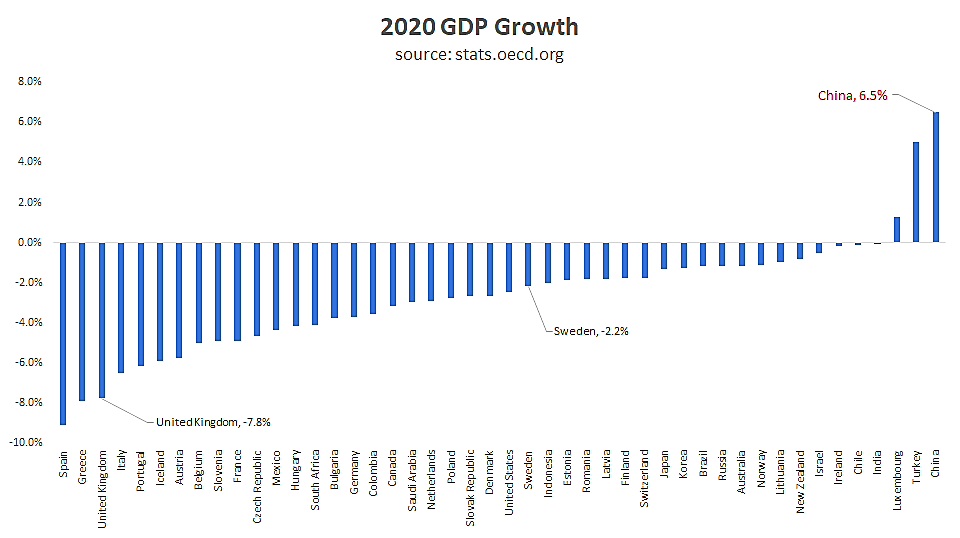
This simple graphic represents the net effect of the policies of the new world order globalists, including Covid-19 policies, green/sustainability/global warming energy policies, and open borders multiculturalism and illegal immigration policies. The U.S. and other countries have gone into decline following booming economies in 2019.
Saul Alinsky, Karl Marx, Vladimir Lenin, the UN, the Club of Rome, Bill Gates, George Soros, The Counsel on Foreign Relations, The U.S. Congress, The Democrat Party, The European Union, Black Lives Matter, Antifa, The Muslim Brotherhood, the Chinese Communist Party are accomplishing their goal.
By now everyone knows that the global economy was suppressed in 2020 by Covid-19 policies. One result is human-produced carbon dioxide (CO2) emissions were reduced by estimates of 25% to 30% because use of fossil fuels for travel, energy for businesses, etc was dramatically reduced during 2020. If human CO2 is a statistically significant contributor to total CO2 atmospheric concentration, then we should be able to observe a significant decline in total CO2 concentration during 2020. Instead total CO2 has increased.
Since the late 1970’s, net global atmospheric CO2 concentration has been monitored by a network of labs coordinated by the Keeling lab run by NOAA on Mauna Loa on the Big Island of Hawaii (1). These data are publicly available in many formats which anyone can download and analyze. The graphic above is directly from their website with no modifications. Note there has been a continuation of the ongoing slope, the slowly increasing CO2 trend, between February 2020 and February 2021.
“A necessary condition for the theory of anthropogenic global warming is that there should be a close correlation between annual fluctuations of atmospheric CO2 and the annual rate of anthropogenic CO2 emissions.” (2) If human-produced CO2 is a statistically significant contributor to the trend of net global average CO2 concentration, then we must see a reversal of slope (change in sign) and decline in this graph and in the data. These data visually demonstrate scientific and statistical findings made years ago by many scientists (e.g. Salby, Munshi, Spencer) that the statistical signal of human produced CO2, primarily from burning fossil fuels, is not detectable – too small to reach statistical significance, too small to be detected with precision above the noise/variability in the trend of net global CO2 concentration. Other natural sources and phenomena adequately explain this many-decades-long trend in global CO2 concentration.(3)(4)
The continuing addition of fossil fuel CO2 emissions must be detectable (correlated with) a change in the slope of net global atmospheric CO2 concentration if the theory of human-caused global warming is valid. The Mauna Loa data is sensitive enough to easily see annual spring-summer seasonal changes, visible here as the sharks teeth in the trend line. This clearly indicates that the data are sensitive enough to see changes in trend. Emissions from fossil fuels are clearly less that these seasonal CO2 changes. Yet, the UN IPCC, your government and its agencies and many others insist that fossil fuel produced CO2 emissions are the primary cause of the rising CO2 trend, which they claim is dangerous and human-caused. They trot out continuous catastrophes, fear mongering propaganda, scared children, the need for carbon taxes and the elimination of all fossil fuels. In these NOAA data and many other studies, we observe fossil fuel emissions are insignificant, trivially much too small to significantly affect climate. Therefore, the theory of human-produced global warming (AGW) is falsified according to the scientific method.
A correlation does not prove that a cause and effect relationship exists. However, the absence of a significant correlation means no cause and effect relationship exists. If there is a cause and effect relationship then there must be a correlation, or else the theory is falsified. Despite this obvious failure, burning fossil fuels is claimed to be the cause of dangerous warming.
No correlation is detected, no perturbation of trend is detected, no change in second derivative is found. There is no correlation with the known decline in fossil fuel emissions which occurred during 2020. The approximate 2 ppmv per year CO2 slope continues during 2020 into 2021. If CO2 from fossil fuels were statistically significant to the trend of total CO2 concentration, then we should see a change in sign of slope and a steep decline in CO2 concentration. But instead CO2 increases. CO2 emissions from burning fossil fuels is not statistically significant with regard to the ongoing trend in net global CO2 concentration, nor with any climate variable which has a significant co-dependence with net global CO2 concentration, for example average global temperature, or “greening of the planet,” or radiative emissions from greenhouse gases, or climate forcing.
This is not a new finding or even surprising to those with open minds. But this science is not reported in the news, nor in government publications, UN, academic labs funded by government and NGOs, Wall Street banks, The World Bank, NASA, NOAA, EPA, giant corporations, or globalist elites. There is a massive global fraud in play right in front of us. I have no doubt that these people will find a way to “adjust” these data to support their agenda.
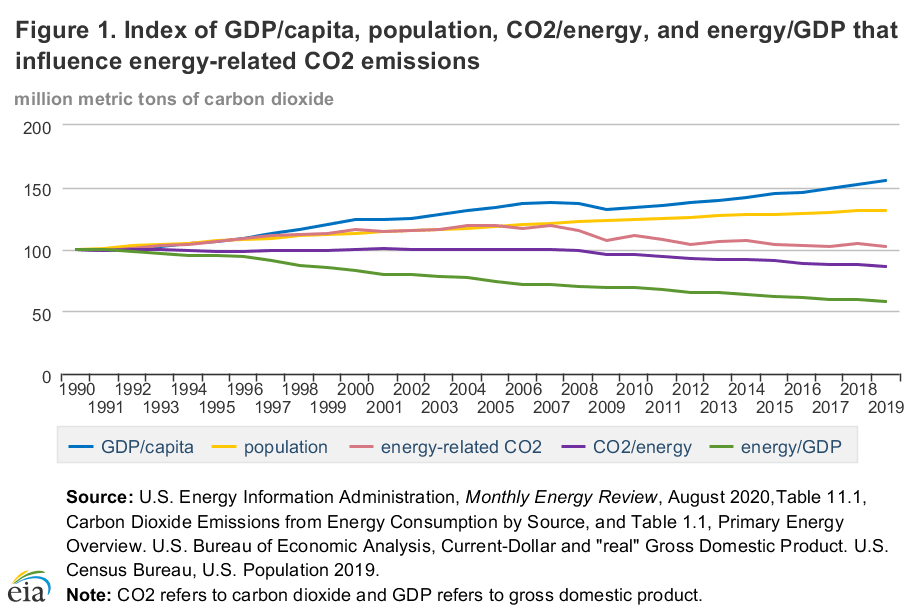
* U.S. energy-related CO2 emissions decreased 2.8% (150 million metric tons) in 2019 and were close to 2017 levels.
* Energy‐related CO2 emissions in the United States decreased by 2.8% (150 million metric tons [MMmt]) from 5,281 MMmt in 2018 to 5,130 MMmt in 2019 (Figure 2).
* The overall carbon intensity (CO2/GDP)[3] of the U.S. economy declined 4.9% in 2019. This decline resulted from a 3.0% decrease in energy intensity and a 2.0% decline in the carbon intensity (CO2/energy) of the energy consumed.
* Since 2007 energy-related CO2 emissions have declined eight out of 12 years.
* As indicated in Figure 1 and the related discussion, after the economic recovery from the recession, energy-related CO2 emissions began to diverge from population growth, and on average they began to decline. The year 2019 was typical of the declining years that average about -3.0%.
By Paul Homewood . . I have been warning for some time that the real objective of the greens is to take our cars away from us. Forcing us to buy ridiculous electric cars, which are totally unsuitable for many drivers, road tolls, cycle lanes etc have nothing to do with saving the planet. It…
I am very sorry to point out that this is the result of identity politics and community organizers. Perhaps you believe you are liberal or progressive. But, this is where wokeism leads. It is racism by another name. America is regressing to the class-based social structure that most Americans fled in previous generations. It enables feudal fiduciary master/slave relationships and according to global elites who believe they know what is best, a class-based society is the optimum social structure. But of course few of them would say that in public. They use Newspeak instead. Inclusion equals exclusion, etc.
This is the return of aristocracy, Übermensch, fascism and global wars.
World renown vaccine specialist, Geert Vanden Bossche, gave a groundbreaking interview this week risking his reputation and his career by bravely speaking out against administration of #Covid19 vaccines. In what may be one of the most important stories ever covered by The Highwire, the vaccine developer shared his extreme concerns about these vaccines in particular and why we may be on track to creating a global immunity catastrophe.
His bio is presented in this video as well as an interview with him.
Over the last week, we have been sharing compelling informaton on how Covid-19 can take advantage of suboptmal S-specifc antbodies (Abs) to evade the host immune system. The virus will only exploit this opportunity when the immune pressure raises to a point where its replicaton is jeopardized. As previously explained, Covid-19 will implement this ‘escape’ strategy when its replicaton becomes severely hampered, e.g., due to stringent infecton preventon measures (hence why we’re now dealing with an increasing number of highly infectous variants). Mass vaccinaton will dramatcally increase immune pressure on the virus while opening additonal emergency exits. Because of enhanced infectousness and spread of Covid-19, the virus will, indeed, increasingly infect subjects whose Abs are suboptmal (because too low in concentraton and/ or afnity). Suboptmal Abs enable the virus to select mutatons capable of strengthening its binding to the ACE2 receptor, thereby enhancing its infectousness and eventually allowing ACE2 to outcompete vaccinal Abs for binding to its spike protein (resultng in viral resistance to the vaccines) .
For those who may have some difculty in understanding how mass vaccinaton drives viral immune escape, it will sufce to watch infectvity and morbidity rates in those countries who have now succeeded in vaccinatng millions of people in just a few weeks (e.g., UK, Israel, USA). Whereas these countries are now enjoying declining infectvity rates, they will undoubtedly start to sufer from a steep incline in Covid-19 cases in the weeks to come. The steep decline we’re seeing right now may be followed by a short-lived plateau but a subsequent steep incline of (severe) disease cases is inevitable.
Unfortunately, it’s only when the world will witness how morbidity and fatality rates start to dramatcallyincrease despite ever growing vaccine coverage rates that health policy makers will fnally realize that things are going in the wrong directon. Only then will the disastrous consequences of mass vaccinaton campaigns become obvious to WHO and our politcal leaders. Unfortunately, this may stll take another couple of weeks. The price to be paid for the loss of this precious tme is just beyond what one can imagine.




 budbromley
You must be logged in to post a comment.