That major body of work dovetails with Henry’s Law. They are complementary refutations of the theory of human-caused global warming/climate change, one positive, one negative. Together they falsify the theory of human-caused global warming/climate change.
Henry’s Law explains how CO2 (whether human or natural or both combined) can never cause global warming or cooling, simply said, because any increase in CO2 in air is offset by an equal increase in solubility of CO2 in water until the Henry’s Law CO2 equilibrium between air and water is restored. And vice versa: any decrease in CO2 in air by sequestration or emission reductions is offset by an equal reduction in solubility of CO2 in water until the Henry’s Law CO2 equilibrium between air and water is restored.
The continuing and upcoming cooling due to the grand solar minimum will increase solubility of CO2 in ocean surface and water everywhere, resulting in reduced atmospheric CO2 concentration, which means all plant life will have less food. (See graphic of tree growth below by Dr. Idso.) This cooling will be very dangerous to food supplies and all life. This is explained in detail by Professor Zharkova’s body of work.
This danger will be amplified in combination with multiple, foolish human geo-engineering projects which are planned and underway as described below.
CO2 solubility in water (and solubility of all gases) is inversely proportional to temperature. (graph immediately below.)
Le Chatelier’s principle and the Law of Mass Action inform us that disturbances to equilibria are reset in speed and quantity based on the speed and quantity of the disturbance to equilibria.
In addition to the above Bill Gates/George Soros plan already underway, there is also:
Marine Cloud Brightening is a research project led by Southern Cross University as part of the $64.55 million, or 100 million Australian dollars, Reef Restoration and Adaptation Program. The program involves modifying clouds to make them reflect sunlight away from the Earth to supposedly stop global warming.
Slay News reports:
“This week, researchers aboard a ship off the northeastern coast of Australia near the Whitsunday Islands started spraying a briny mixture through high-pressure nozzles into the air in an attempt to brighten low-altitude clouds that form over the ocean.
“Scientists hope bigger, brighter clouds will reflect sunlight away from the Earth, shade the ocean surface, and cool the waters around the Great Barrier Reef.”
In another nightmarish plan:
In Israel, another startup called Stardust Solutions has begun testing a system to disperse a cloud of tiny reflective particles about 60,000 feet in altitude.
These geoengineered clouds reflect sunlight away from Earth to cool the atmosphere in a concept known as solar radiation management.
And in yet another nightmarish geoengineering project:
In Massachusetts, researchers at the Woods Hole Oceanographic Institution are preparing to pour 6,000 gallons of a liquid solution of sodium hydroxide, a component of lye, into the ocean 10 miles south of Martha’s Vineyard this summer. I am going to guess that this one eventually will be stopped because Obama has a massive estate on Martha’s Vineyard. But, you never know, John Holdren (picture below) was President Obama’s chief science advisor. Holdren ran Woods Hole Institution for years, and probably is back there again. Holdren is the “true believer” scientistbehind Obama’s EPA and CO2 Endangerment Finding. Holdren has been on this human-CO2-caused global warming agenda since the 1960’s when he published a book titled “Ecoscience” (see picture below) about global warming, overpopulation and the need for eugenics population control, written with the author of the book “The Population Bomb” Stanford professor Paul Ehrlich (see picture attached.) Many “baby boomers” read Population Bomb in the 60’s or 70’s, and may notice that predictions in the book have not happened, which of course is also true for almost all predictions from climatology.
Prof. V. Zharkova, a Ukrainian-born British solar researcher of Northumbria University, Newcastle, with a solid academic background, has been warning about a dangerous phenomenon that could lead to dramatic climate and weather changes as well as global cooling for 30 years as shown in the Nature SR paper by Zharkova et al, 2015 and clarified in Zharkova, 2020.
Zharkova used Principal Component Analysis (PCA), a mathematical method to detect own oscillations of solar background magnetic field (SBMF), which has produced 97 percent accuracy in mapping the SBMF variations for the past 4 solar cycles. These SBMF variations were shown linked to the movement of sunspots (Zharkova et al., 2023a) used currently for definition of solar activity. Sunspots are roots of magnetic loops embedded into the solar surface (photosphere), representing the cooler regions of the sun’s surface that move around periodically and appear darker when photographed. We say cooler, but really these sunspots still maintain incredible temperatures of around 4,200 degrees Celsius.
Media worldwide covered this upcoming grand solar minimum in 2020-2053 which will bring a reduction of solar magnetic field, solar activity and terrestrial temperature similarly to that during Maunder minimum in 17 century.
Later in Zharkova et al 2019 she demonstrated that magnetic field of the sun also undergo two millennial oscillations of its baseline caused by the shift of the Sun towards or from the terrestrial orbit caused by the gravitation of large planets, called solar inertial motion (SIM). This article suggested that the current global warming is aa part of usual Hallstatt’s cycle of the solar irradiance oscillation caused by this SIM. The paper was retracted by the Editor of SR on demand of the AGW people claiming that the Sun-Earth distances do not change as predicted by SIM.
However, later Zharkova, 2021 presented the official ephemeris of the Sun-Earth distances in the last two millennia 600-2600 proving the conclusions of their paper by Zharkova et al 2019 that the Sun-Earth distances change very significantly during ~2000-2300 years period. These baseline oscillations were regularly seen in magnetic field variations in the past 120,000 years and observed in solar irradiance restored by a few authors for the Holocene as shown in the book chapter by Zharkova, 2021 and recent paper by Zharkova et al, 2023b.
Her studies have become controversial over the years because Zharkova has shown that the current climate changes is caused by the orbital motion of the Sun and variations of the solar activity not being related carbon dioxide variations. Zharkova emphasized that the global warming will become irrelevant in the next three decades during the modern grand solar minimum (GSM), which started in 2020 and will last until 2053, This GSM will cause a decrease of the average terrestrial temperature by up to 1oC in the next 30 years and not its increase as warned by the IPCC people.
In a 2019 interview with the award-winning Canadian journalist Stuart McNish on his program “Conversations That Matter,” Valentina Zharkova, who authored world-leading research as well as numerous ground-breaking publications, explained that they have been observing signs that since 2015, solar activity has been decreasing in a manner only seen during the Grand Solar Minimum, which last occurred during the Maunder Minimum, also known as the “prolonged sunspot minimum,” seen 400 years ago.
Zharkova V. cited National Oceanic and Atmospheric Administration (NOAA), National Aeronautics and Space Administration (NASA), and other research organizations have noted this trend in various ways but hid the information from the public. According to her, tsignificantly reduced solar activity will inevitably lead to dramatic climate and weather changes such as a massive global cooling that could be likened to a mini ice age. (Related: NO WARMING AT ALL: Global COOLING continues for eighth straight year, according to NOAA data.) The independent news outlet raised people’s concern about the globalists’ Agenda 2030 and claims of “human-induced global warming,” which are supposed to affect us in the early 2030s.
“Between cycle 25 and 11 years of cycle 26 [the least active cycle], and between cycle 26 and 27, will be the coldest period on Earth, and we will feel it through a lack of vegetation,” the researcher and lecturer with a doctorate in astrophysics said. This means that starting after the active period during the ‘Solar Cycle 25,’ from the second half of this decade until the early 2050s, Earth will experience exceptional cold, extreme weather, earthquakes, and volcanic eruptions. Zharkova pointed to 2030 as the year when it will seriously begin, warning that the 2030s will be so cold that it will result in a severe food shortage.
“The question is why they are not warning us about what is truly on the horizon, as they are likely well aware of it. Even more concerning is why they are misleading the world’s governments and people into believing that the threat is warmth. Potential answers to these questions are unsettling,” the article read.
Prof. V.Zharkova’s credentials. V. Zharkova (https://solargsm.com) has published over 200 articles, including four articles in Nature-affiliated journals. On 27 May 1998, Prof.Zharkova and S, Kosovichev of Stanford University, US published in Nature journal a paper reporting discovery of a sunquake induced by a solar flare detected by the Michael Doppler Imager abord of the SOHO satellite. Solar flares are intense localized explosions of electromagnetic radiation, particles and waves in the sun’s atmosphere, which strongly affect the terrestrial atmosphere causing Aurora Borealis and affecting the electric energy grids on Earth.
V. Zharkova and her PhD student Druett M. in another Nature Communications paper (Druett et al, 2017) explained the blue and red shifts in the spectral lines and continuous emission of Hydrogen atoms observed during solar flares. This solar plasma research was done for the addition to the Nature Scientific Reports articles in general solar activity that predicted the modern Grand Solar Minimum between 2020 and 2053 (Zharkova et al, 2015) and the role of the Sun and global warming because of the solar inertial motion induced by the gravitation of large planet of the Solar System (Zharkova et al 2019; Zharkova, 2021).
Letitia Ann James (born October 18, 1958) is an American lawyer and politician serving since 2019 as the Attorney General of New York (NYAG), having won the 2018 election to succeed Barbara Underwood. A member of the Democratic Party.
As NYAG she brought a civil case against Donald Trump wherein Trump was the only victim. Everyone else involved profited. The judge is also complicit in this travesty.
Meanwhile, real crime is growing and goes unpunished in New York state and New York City. Businesses and population are leaving and illegal aliens are flowing in.
The judge delivered the $350 million penalty so that a bond in that amount must be paid before Trump can appeal this travesty of justice.
Rumors and underground news report truckers are planning to halt deliveries in New York City. Interviews on the street in the city have some claiming they will use illegal aliens to drive trucks for deliveries.
“DEVELOPING – BANKRUPTING TRUMP: If you haven’t been paying attention, Donald Trump currently owes $87,500 in daily interest on a half-billion-dollar fine in his Manhattan case. This interest will continue to accrue until he settles the half-billion-dollar penalty. In other words, every day when you wake up, another $87,500 is added, and the same will happen the following day until he can pay it off. Even if he appeals, he will still have to pay upfront and only potentially get his money back if he wins. The New York Attorney General has stated that she might seize his buildings if he cannot pay. This is the most effective way to bankrupt someone and prevent them from running for office.”
“Hands down, the baddest man on the planet. Retired Chief Petty Officer David Goggins is the only person to ever complete US Army Ranger School, US Air Force Tactical Control Party Training, and US Navy Seal Training. Individually, each of these training programs are nearly impossible to complete. He not only completed the training, but served honorably, completing numerous combat missions in each capacity. David Goggins is an American hero and we may never know the true extent of all he has done for our country. He is a Guinness World Record holder and widely regarded as “the baddest man on the planet…” ~Hat tip to Shaney Boy on X.
Dan Bongino on The Dan Bongino Show, Feb 16, 2024. Bongino is a former U.S. Secret Service Agent who worked in the White House during the Obama administration.
Must watch and listen
“I don’t trust the FBI at all…at all…not even a little bit. We live in a police state right now. There’s great men working down there in the streets doing bank robberies and stuff…The management of the FBI, I don’t trust them one bit …not one single bit. Folks, I don’t buy anything from those people, anything, trust no one in government.” ~ Dan Bongino
“Mike Pompeo is supposed to be a friend. Is he? He was Trump’s first CIA Director. Gina Haspel is no good. Did Pompeo recommend Haspel?” (Haspel was Trump’s second CIA Director.) ~ Dan Bongino
Haspel ran the London CIA office when the Steele Dossier was being cooked up. These people knew about and/or were involved in the Russia collusion plot to spy on candidate and President Donald Trump, the Steele Dossier, etc. , now disproven, which eventually led to the ~ failed effort to impeach and remove President Trump, and ultimately the raid on Trump’s Mar-a-Lago home supposedly to recover secret documents held illegally by Trump, when what FBI and DOJ wanted were documents in evidence of FBI, CIA involvement in the plot to frame, impeach and remove Trump.
Dan covers several different examples, including the January 6 “bomb” threat at the D.C. HQ for the Democrat National Committee, supposedly an intended attack against VP elect Kamala Harris, which was really a conspiracy known and run by the FBI, CIA, and Secret Service which they are attempting to blame on the MAGA attendees at the January 6 rally at the capitol, and ultimately they will try to tie to Trump.
You’d be wise to watch this great 2-hour discussion with Professor Bret Weinstein, a renowned Biologist and Classical Liberal about the greatest crime ever that was ever committed against humanity in world history and the ongoing destruction of Western Civilization by the global elite and the unwitting, “useful idiots” who blindly follow them. Weinstein is interviewed by Alex Jones at the first link and Tucker Carlson at the second link.
Weinstein and Jones mention the book by RFK Jr. titled The Real Anthony Fauci. It can be downloaded for free here as a pdf file, or down below at the link on Children’s Health Defense.
Trump did a lot of stupid things – running his mouth – spending too much, listening to Fauci and Birx, but not listening to Will Happer and others, but we were 20% wealthier and not at war.
Unfortunately, worldwide politicians, governors and mayors and their police fell in line with the global elitists, pharmas, so-called government experts and academics. But, as Catherine Austin Fitts explains with Paul Buitink, a financial reviewer, the global awakening is going full steam ahead now.The pushback against globalist wokeness is strong and growing.
2016 Candidate Trump indicated he would repeal the EPA Endangerment Finding on CO2 and he hired Princeton professor of physics Will Happer for that purpose. But Trump did not follow through, nor explain. Happer left the Trump administration, no doubt in frustration. Today, Trump again is talking against the climate scam. Election talk? Will he actually do anything this time to oppose this blatant globalist fraud, estimated by McKinsey to cost $9 trillion per year worldwide, a historically large scam supported by all of the big banks, McKinsey, IMF, WHO, EU, EPA, Democrats, and all the usual suspects. Just one example among many of the giant money laundry now underway. Catherine Fitts at least believes the people of the world are now awake, exampled by the the farmers and truckers convoys and marches in many countries.
Another example, the covid scam. Will Trump admit his crucial mistake on covid and reveal the real globalist + government conspiracy?
More on the globalist money laundry…and a solution…Catherine Austin Fitts at this video link. (bio below).
CatherineAustinFitts (born December 24, 1950) is an American investment banker and former public official who served as managing director of Dillon, Read & Co. and, during the Presidency of George H.W. Bush, as United States Assistant Secretary of Housing and Urban Development for Housing.
MANAGING PARTNER
CATHERINE AUSTIN FITTS
Catherine is the president of Solari, Inc., publisher of the Solari Report, and managing member of Solari Investment Screens, LLC.
Catherine served as managing director and member of the board of directors of the Wall Street investment bank Dillon, Read & Co. Inc., as Assistant Secretary of Housing and Federal Housing Commissioner at the United States Department of Housing and Urban Development in the first Bush Administration, and was the president of Hamilton Securities Group, Inc.
Catherine has designed and closed over $25 billion of transactions and investments to-date and has led portfolio and investment strategy for $300 billion of financial assets and liabilities.
Since 1980 I have said openly that global warming is the second largest fraud in history. Then I would usually explain details on the global warming fraud, perhaps boring some people. But, this past week the UN revealed the scope of their global warming fraud by demanding – with fear mongering threats – over $100 TRILLION between now and 2030, or else – they scream – life on earth will end. They are screaming FIRE in a theatre, and give us your money so we can put out the fire, but there is no fire.
Only a handful of people have ever asked me, what is the largest fraud in history? My simple answer has been: the conversion of assets globally into U.S. dollar-based debt. Assets turned into liabilities. A debt-based global economy, instead of an asset-based economy wherein you own your private property. It’s one of these stories that is happening right in front of us, we are all participating in it, but it is so big we have difficulty describing it and its tentacles that extend everywhere, and it is even more difficult to understand. In fact the global warming fraud is one of those tentacles. As is Obamacare, etc.
If you are not interested in statistics and such evidence, then please scroll down to the section titled “The Strengthening Case for a Lab Origin” for the natural-science-based argument.
This article is eArchived here as originally posted just in case the original blog is deleted. You are encouraged to read the original at the link above.
Original post
The Strength of Evidence for a Lab Origin: Probable cause, preponderance of evidence, and beyond reasonable doubt
By Alex Washburne, January 28, 2024
I had previously made the case that the totality of circumstances surrounding SARS-CoV-2 origins is sufficient for probable cause to believe the virus originated in a lab. In addition to the circumstances surrounding the origin of SARS-CoV-2, the evidence we lack for a zoonotic origin makes our case even stronger.
Outside the narrow lens of mainstream media outlets unable to cover this globally pertinent forensic case, the biggest scientific murder-mystery of the century is being solved.
New evidence has emerged to strengthen the lab origin case. The flawed papers claiming a zoonotic origin have been revealed as even more hopelessly flawed – while those of us independent subject matter experts could see this from the beginning, now it is becoming more obvious even to the lay public. Additionally, the lab origin theory has made remarkable predictions about the contents of recently FOIA’d drafts of the DEFUSE grant. The case for a lab origin is now clear enough that not only can we see the lab origin beyond reasonable doubt, but we are starting to accumulate evidence consistent with a cover-up, that this research-related accident was known to some who knew they funded the work, who knew they subcontracted the work, and who knew they did the work.
Let’s recap what we already knew, what’s new, and what we can reasonably deduce about who knew what & when.
The Fall of the Zoonotic Origin Papers
SARS-CoV-2 is a bat sarbecovirus that emerged in Wuhan far from the hotspots of wildlife bat sarbecoviruses, in a city without bats, at the doorstep of the Wuhan Institute of Virology, the largest repository of bat sarbecoviruses in the world.
The outbreak started sometime in October-November 2019, well before the Huanan Seafood Market outbreak. While Worobey et al. claimed “early” cases were centered around the wet market, they failed to account for earlier cases preceding the wet market outbreak, the Chinese government’s order to destroy early cases or the ascertainment protocol that required a connection to the wet market, and a study of social media data indicated the earliest surge in care-seeking terms was not near the Huanan Seafood Market, but across the river at hospitals nearest to the Wuhan Institute of Virology.
New: Michael Weissman, a quantitatively sharp physicist who has been estimating the likelihood of lab vs. zoonotic origin theories, made a simple observation that shows Worobey et al.’s own analysis disproves their own assumptions & conclusions. Worobey et al. report that the average distance to the wet market from “unlinked” cases was lower than the average distance to the wet market from cases linked to the wet market. This is a statistically significant indication of sampling bias – if there were no sampling bias, no preferential ascertainment of cases based on proximity to the wet market, then these distances should be the same, or unlinked cases perhaps farther.
Worobey et al. made conclusions based on the assumption that unlinked cases were ascertained at random, but their own analysis disproves that assumption and thereby reveals what we’ve said all along: these early cases are a biased view of the early outbreak provided by the Chinese government. Cases preceding the wet market, surges of care-seeking terms near the Wuhan Institute of Virology, and the statistically proven biases of the wet market dataset all but disprove the wet market hypothesis, leaving us with no evidence supporting a natural explanation for why a bat sarbecovirus arose in a city without bats, but with a lab specializing in bat sarbecoviruses.
Pekar et al. also tried to claim the early evolutionary tree of SARS-CoV-2 is highly unlikely to have occurred by chance under one introduction, and they estimated a Bayes Factor of 60 for the two large branches at the base of the SARS-CoV-2 phylogeny (i.e. they estimated the evolutionary tree we observe is 60-times more likely under a zoonotic origin than lab origin). Colleagues and I showed this paper did not justify its conclusions in many ways: (I) their model of evolution was inaccurate (they used a model for HIV evolution instead of SARS-CoV superspreading) and this model made big-branches less-likely (II) their model of case ascertainment, like Worobey et al (written by the same group), was wrong and biased case-ascertainment through contact or location tracing would make two-big-branches more likely, and (III) there are SARS-CoV-2 sequences that meet the authors’ inclusion criteria but which were excluded without cause, and these sequences suggest there aren’t two big-branches but instead intermediate lineages, completely undermining the empirical premise of Pekar et al.
New: An anonymous poster on X (formerly Twitter) examined the code in Pekar et al. and found they had a bug in their code. The authors fail to estimate the likelihood of two-big-branches under alternative scenarios and consequently their estimated Bayes Factors are not actually Bayes Factors. This bug in the code, alone, drops their not-a-Bayes-Factor of 60 to a Bayes Factor of 3, which is within the realm of noise, and that’s not accounting for the additional biases, model inaccuracies, and statistical challenges colleagues and I identified.
The end result is that the evolutionary tree of SARS-CoV-2 does not provide any evidence of multiple spillover events. This end result is important evidence in favor of a lab origin. We have seen a single SARS-CoV spillover in 2002 when an animal trade outbreak led to an infection of civet handlers across a vast geographic scale of Guangdong Province. The viruses circulating in civets were genetically diverse and consequently the evolutionary tree of viruses infecting civet handlers had many branches, one for each spillover event, and those branches differed by more than just 2 mutations that separated the two big branches at the base of the SARS-CoV-2 evolutionary tree (which could occur in a single human-human transmission event).
An animal trade network is the primary way a bat sarbecovirus with close relatives in faraway Yunnan Province could get to Wuhan, but animal trade outbreaks leave footprints. Animals are housed together and in close contact with animal handlers over many miles and across many cities. Like other outbreaks along food-distribution networks (think: salmonella on lettuce), the SARS-CoV-1 outbreak infected people across the entire distribution network of the food or animals. Civet handlers became ill in separate spillover events across all of Guangdong Province. SARS-CoV-2, on the other hand, did not leave a trace between Yunnan and Wuhan, the Chinese government only locked down Wuhan yet there were not reported outbreaks outside of Wuhan or Hubei province.
The Chinese government limited PCR tests to travelers coming from Wuhan, and focusing testing on such a narrow area is a strange public health policy for any country trying to contain an animal trade outbreak with a geographically broad precedent. Another strange public health policy was the CCP ordering the destruction of early cases. If there was an animal trade outbreak, then we should test widely along the entire network and fear additional spillover events in geographically disparate locales getting animals (e.g. raccoon dogs) from the same trade network. In such a geographically broad outbreak across a trade network with the potential for multiple spillovers, earlier cases are exponentially more valuable for the information they contain about the cause of spillover, the animals infected, the particular lines of animal trade networks to monitor, and how we might bottle-up the leak from animals to people.
The Strengthening Case for a Lab Origin
All of these anomalies of SARS-CoV-2 emergence, SARS-CoV-2 evolution, and CCP outbreak policy, however, make perfect sense if the leak was not from animals to people, but from the world’s largest repository of bat sarbecoviruses in the same city, walking distance from both the wet market and the hospitals at the heart of earlier surges in care-seeking terms.
The lab origin theory examines the possibility that SARS-CoV-2 may have leaked from a lab, and to fully understand a lab-origin theory one must examine the research being conducted by the lab. It just so happens that there is a bat sarbecovirus lab in the same city where this bat sarbecovirus emerged; the specificity of the connection between the virus that emerged and the lab is so high it’s like finding a tiger roaming around the town walking distance from a big cat sanctuary in Germany, so knowing there is a sanctuary drawing in big cats from around the world provides critical context for the big cat roaming the streets nearby. The Wuhan Institute of Virology was a leading institute for studying wildlife coronaviruses. These researchers would catch all manners of animals and even sample animal trade networks in search of new viruses. They would take these wildlife viral samples back to Wuhan for further study, and in collaboration with EcoHealth Alliance they would import wildlife viral samples obtained by external, US-based parties.
The wildlife virological work in Wuhan is important context, but the single most important thing to know about the lab origin theory is a grant written in 2018 – the DEFUSE proposal. The DEFUSE proposal was pried from the unwilling hands of EcoHealth Alliance by DRASTIC, the group of independent sleuths investigating a lab origin theory since 2020.
DEFUSE was submitted to the DARPA PREEMPT call. By pure happenstance, I have intimate knowledge of this call because I helped write a successful DARPA PREEMPT grant, I was working on a DARPA PREEMPT team for 2 years pre-COVID (and a DARPA YFA on bat viruses since 2017), and I attended the meeting in DC where we got to hear from other DARPA PREEMPT teams. Consequently, I can read DEFUSE and put it into context of the grant call & other contemporary work in the field, and I can quickly identify the characterizing features of DEFUSE revealing the unique research goals and intentions of the authors that differ from broader wildlife virological work.
The DARPA PREEMPT call aimed to preempt pathogen spillover. The call sought proposals to identify “jump-capable quasispecies”, a rather new term that referred to strains of pathogens with an increased ability to jump the species barrier, especially those with an increased ability for onward transmission in humans that could cause a pandemic. Then, to preempt spillover, the call sought proposals aiming to somehow prevent wildlife from acquiring these jump-capable quasispecies and/or interventions that reduced the risk of humans overlapping with wildlife at times & places when they had these jump-capable quasispecies.
To give you an example of a DARPA PREEMPT grant, let me share a bit about the grant I was on. I was part of a team studying bat henipaviruses like Hendra, Nipah, Cedar etc. We proposed to have a vast international team catch bats across Africa, SE Asia, and Australia, sample bats for henipaviruses, and characterize when & where we find infected bats as well as the genetic diversity of their henipaviruses. The most important barrier to entry for most wildlife viruses is a step in the virus life cycle called “receptor-binding”, or latching onto the receptors of new hosts, so we would focus our studies of quasispecies phenotypes by having labs make the receptor-binding proteins of henipaviruses in the lab (not the whole viruses) and test their ability to bind human receptors. For a small set of jump-capable quasispecies, we would try to culture the viruses in a BSL-4 lab (the highest possible biosafety level), and we would develop vaccines against these quasispecies identified from the wild.
DEFUSE proposed to sample bat sarbecoviruses in SE Asia, but they didn’t propose to examine the extant variation of sarbecoviruses in nature, instead they were searching for a highly specific genomic feature that has never been seen before in sarbecoviruses: a furin cleavage site (FCS). This, alone, is highly unusual – why would they bet an $15 million grant on searching for a feature that had never been observed in nature before? Furin cleavage sites had been documented in very distant coronaviruses such as MERS-CoV, feline alphacoronaviruses, or some endemic human coronaviruses, and across the board it was recognized that the FCS enhances the ability of a virus to bind receptors and enter the cells across a wider range of host receptors and cells. DEFUSE proposed to search for furin cleavage sites and if they found one, insert the FCS inside more-abundant strains to test their transmissibility. The viral assays and work with humanized mice (e.g. testing transmissibility of a virus with an FCS) would occur not in Buenos Aires, not it Atlanta, not in Cape Town or Sydney, not even in Beijing… it would occur in Wuhan. Finally, these researchers would construct a vaccine against such a sarbecovirus and vaccinate bats to preempt spillover.
Kudos to the grant’s focus on receptor-binding & cell entry, but their identification of a never-before-seen motif is highly unusual. None of the other PREEMPT teams proposed to make things not found in nature. The proposal to search for something never before documented and swap it around other viruses in hypothesized recombination events is not the direction evidence flows in wildlife virology. Wildlife virologists look at what we find in wildlife, and study what we find in wildlife, we don’t use our imaginations to make unnatural chimeric innovations not found in wildlife and then conjure these horrors into existence.
SARS-CoV-2 emerged in Wuhan with a furin cleavage site never before seen in a sarbecovirus. It needs to be emphasized that, to the best of our global knowledge, “sarbecovirus with furin cleavage site” did not exist in nature before 2020, but it did exist in a grant proposal to make something not found in nature, and that biological novelty was proposed to be made in Wuhan. The exact furin cleavage site found in SARS-CoV-2 is found in another protein, a protein called alpha-ENaC found in humans and studied heavily at the same university (UNC) as one of the PI’s of DEFUSE.
New: Drafts of the DEFUSE grant recently obtained by Emily Kopp at US Right to Know found several pieces of evidence strengthening the connection between DEFUSE and the furin cleavage site found in SARS-CoV-2. First, the leader of DEFUSE, EcoHealth Alliance President Peter Daszak, mentioned in a comment that, while they would propose to do some of their riskier work in the BSL-3 labs of UNC, after acceptance of the grant they could offload that work to the BSL-2 labs in Wuhan. These comments amount to a conspiracy to deceive and defraud the US DoD in their grant and cut corners in biosafety to cut costs, conducting more risky work not in Buenos Aires or Raleigh or Amsterdam, but in Wuhan. Second, the drafts contain more specific mentioning of “furin cleavage” than the final grant – the final grant hedged bets by emphasizing “proteolytic” cleavage sites, but the drafts fixate on furin, increasing the specificity of the connection between DEFUSE and SARS-CoV-2. Finally, and most importantly, the authors propose a specific location in the genome where they will insert these furin cleavage sites: the S1/S2 boundary, a narrow window in a 3,600 nucleotide gene, and SARS-CoV-2 has its furin cleavage site at exactly the location proposed in these grants.
The furin cleavage site alone should be enough for probable cause given the lack of precedent of this feature in 2018 when DEFUSE was written and the specificity of their proposed insertion matching exactly that seen in SARS-CoV-2. Peter Daszak shows an awareness of the biosafety regulations and intentions of US government agencies, and he conspired to bypass these rules and regulations to cut costs once he received US taxpayer funding for his work.
However, there’s more.
In order to insert a furin cleavage site in SARS-CoV-2, researchers would need to have a DNA copy of the RNA virus. In order to make a DNA copy of an RNA virus, they would construct a “reverse genetics system”. Even the submitted version of DEFUSE mentions that they will use reverse genetics technology to rescue viruses from genome sequences on a computer, swap spike genes, and insert the furin cleavage sites inside these DNA clones to make modified viruses. Two of the three leaders in the field of coronavirus reverse genetic systems were on the DEFUSE grant: Ralph Baric and his former student, Wuhan Institute of Virology’s Shi ZhengLi.
In 2022, Valentin Bruttel and Tony Van Dongen noticed an unusual pattern in the SARS-CoV-2 genome. Two of the most popular bioengineering scissors used to make reverse genetics systems – BsaI and BsmBI – appear to cleave the SARS-CoV-2 genome into 6 segments, and this would make for a highly efficient reverse genetics system. SARS-CoV-2 appears to a bioengineer like an IKEA virus, as if someone had already put time into making sure it could be easily assembled with readily available tools.
We quantified the odds of this pattern appearing in nature and wrote a paper documenting the endonuclease fingerprint in the genome of SARS-CoV-2. Not only is the spatial arrangement of these cutting/pasting sites highly unusual, but the mutations that move them around are exclusively the mutations bioengineers used in prior work, and the concentration of these “silent” mutations is 8-9 times higher within these moved-around stitching sites compared to the rest of the genome. This analysis led us to our theory of a synthetic origin of SARS-CoV-2 by 6-segment assembly, using the enzymes BsaI and BsmBI. The IKEA virus can be ordered in 6 parts and using only the screwdriver of BsaI and allen wrench of BsmBI, you can put the parts together with ease.
New: The same drafts of DEFUSE mentioned above detailing FCS insertion in the S1/S2 boundary also contain more details about their proposed methods to rescue & modify wild viruses from bat samples. Specifically, after EcoHealth shipped bat samples to Wuhan, they proposed to sequence the samples and rescue bat sarbecoviruses using reverse genetic systems assembled with “6 segments” and in this context they include cost-estimates for the enzyme BsmBI.
The highly precise methodological details contained in the drafts of DEFUSE are exactly the details predicted by the theory that SARS-CoV-2 originated as a research product of DEFUSE-like work.
DEFUSE-like work has been the dominant lab-origin theory, and it’s misleading for people to say that lab-origin theories would originate in any city with a lab because there was only one city with the lab that proposed this highly specific research – this was not proposed to take place in Lima or Mexico City or Alberta or Paris, but in Wuhan. We have evidence Peter Daszak was willing to cut biosafety corners to cut costs and conduct the riskiest work proposed in DEFUSE, exactly the kind of work that could generate SARS-CoV-2, in Wuhan’s BSL-2 labs.
The odds of the alignment between a grant in 2018 and the unnatural, unprecedented genome of a virus in 2019 are nearly zero under a natural origin. My work on the DARPA PREEMPT grant was to forecast the evolution of viruses, so I can state with the confidence of my expertise that the biogeography, epidemiology, public health policy, and genomic anomalies of SARS-CoV-2 are not what you would expect from the natural evolution of a zoonotic virus. The connection between DEFUSE and SARS-CoV-2 is nearly impossible with our 2018 knowledge of wildlife virology and the evolution of wildlife viruses, unless DEFUSE was used as the blueprint, a letter of intent to make a highly specific biological novelty that we found later in the same city where these authors proposed to make it.
DEFUSE was wisely rejected by DARPA, and this has been a common counterargument. However, the DEFUSE PI Peter Daszak had many other sources of funding, including tens of millions of dollars from USAID’s PREDICT program, the Gates Foundation and WellcomeTrust’s CEPI-funded Global Virome Project, and even NIAID.
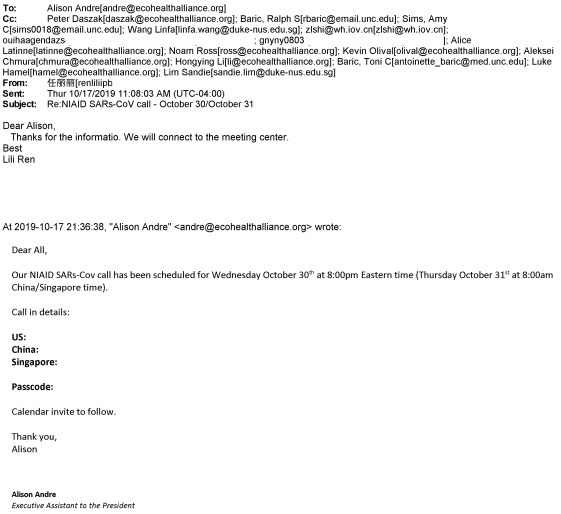
In fact, not only did NIAID fund Peter Daszak through the grant “Understanding the risk of bat coronavirus emergence”, but this NIAID grant also expanded to include all the PI’s of DEFUSE in 2019. The email below from October 2019 contains the primary players of DEFUSE who had never all collaborated and co-authored a document before DEFUSE nor collaborated since (ouihaagendazs is the Wuhan Institute of Virology’s Ben Hu and gnyny0803 is Li Guo). The authors are jumping on an “NIAID SARs-CoV call” on Wednesday, October 30th, suggesting the DEFUSE PI’s whose only known research product is DEFUSE were actively collaborating through NIAID at the time of SARS-CoV-2’s emergence.
Evidence of a Cover-Up
The Wuhan Institute of Virology had a database of hundreds of sarbecovirus genomes and spike genes, but that dataset was deleted in September 2019. The Chinese government ordered the destruction of early cases and sequences, and deleted sequences from NCBI’s servers have been recovered by Jesse Bloom, shining more light on the early outbreak, complicating the evolutionary & epidemiological story of the Huanan Seafood market (what are the odds that sequences deleted corroborate the wet market story vs. complicate it?). The Chinese government only allocated PCR tests to patients in Wuhan with connections to the wet market or travelers coming from Wuhan with connection to known cases in Wuhan, and only Wuhan was locked down, a policy that makes little sense under the SARS-CoV-1 precedent of a geographically widespread animal trade outbreak in SARS-CoV-1. Of course, since SARS-CoV-1 there were 6 lab leaks of SARS-CoV-1 in China, and that could have been the precedent guiding Chinese public health policy.
Peter Daszak, the leader of DEFUSE, did not disclose DEFUSE as a conflict of interest when he was elected to be the US emissary to the WHO’s COVID origins investigation in Wuhan, nor did he disclose DEFUSE when chosen to lead The Lancet’s COVID-origins investigation.
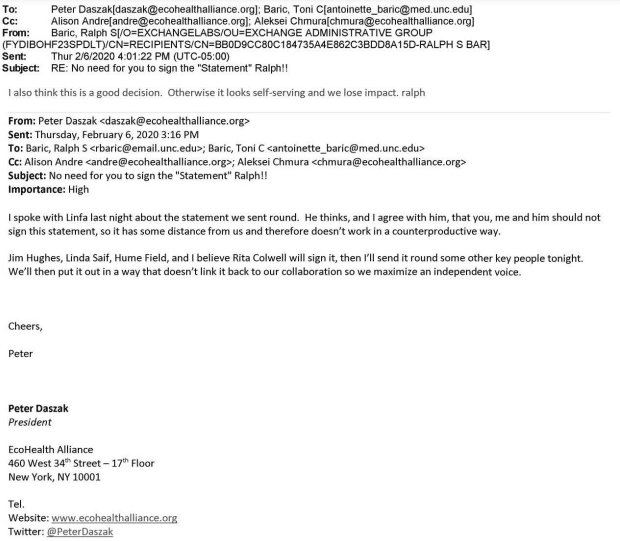
Peter Daszak went even further. Daszak coordinated with DEFUSE colleagues Ralph Baric and Linfa Wang to write an article to The Lancet calling lab origin theories “conspiracy theories”. Not only did Daszak not disclose DEFUSE as a COI, but the email also indicates Daszak’s intent to ghostwrite the article, hide conflicts of interest, all for the purpose of distracting The Lancet’s audience from DEFUSE PIs’ central role working with the lab at the heart of the lab origin theory to design a biological novelty matching the specs of SARS-CoV-2. If the organism described in DEFUSE were patented, SARS-CoV-2 would be an infringement of their patent.
The subject line of Daszak’s email reads:
“No need for you to sign the ‘Statement’ Ralph!!”
Daszak & Linfa Wang agreed that Daszak, Wang, and Baric should not sign the statement they wrote & are organizing “so it has some distance from us and therefore doesn’t work in a counterproductive way”. Baric replied “I also think this is a good decision. Otherwise it looks self-serving and we lose impact.”
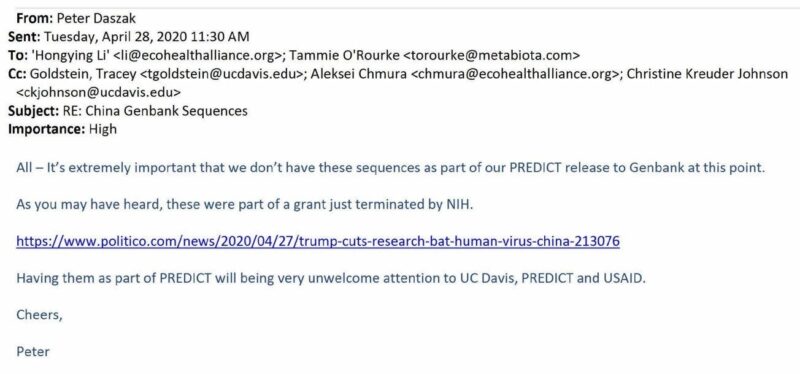
Below, we also have an email in which Peter Daszak wrote his colleagues of USAID’s PREDICT program in April 2020 with subject line
RE: China Genbank Sequences Importance: High
All – It’s extremely important that we don’t have these sequences as part of our PREDICT release to Genbank at this point.
As you may have heard, these were part of a grant just terminated by NIH.
… Having them as part of PREDICT will being [sic] very unwelcome attention to UC Davis, PREDICT and USAID.
Cheers, Peter
The terminated grant in question was the same NIAID grant which brought DEFUSE collaborators together in 2019. What were these China Genbank Sequences of high-importance? Why would these sequences connected to the DEFUSE PI’s NIAID grant bring unwelcome attention? Forgive my insatiable curiosity, but this email makes me want to pay more attention to USAID and their PREDICT project supporting Daszak’s work.
If these sequences were natural bat sarbecovirus sequences and if SARS-CoV-2 were a natural bat sarbecovirus, then China Genbank Sequences would reinforce the evolutionary history of sarbecoviruses, helping us see more clearly that SARS-CoV-2 were a natural virus. If that were the case, few would have a greater incentive than Daszak to disclose these sequences, but instead Daszak chose to withhold them.
If SARS-CoV-2 were a laboratory product of DEFUSE-related work, then it makes sense the NIAID grant connecting DEFUSE collaborators would be terminated and sequences associated with this grant would bring “very unwelcome attention” to those who published the sequences, because somebody like me would look at the sequences and realize they provide even stronger evidence that SARS-CoV-2 was a product of DEFUSE-related work, that the suspects had the genomes on their computers prior to the emergence of this virus. It would make sense Daszak would not disclose DEFUSE nor China Genbank Sequences because he would have a consciousness of guilt. It would make sense he would assert himself as the US emissary to the WHO’s investigation and the leader of The Lancet’s COVID origins investigations without compromising his position by disclosing his conflicts of interest because he has an existential need to ensure investigations come to believe this is a natural virus, even if it is not.
There has remained the possibility that the Wuhan Institute of Virology could have proceeded with DEFUSE-related work without the consent of Peter Daszak. However, that seems unlikely when we examine the way the scientific community operates. Daszak was a ring-leader of a massive global alliance, EcoHealth Alliance, capable of acquiring tens of millions of dollars from USAID’s PREDICT project, the WellcomeTrust + Gates Foundation’s CEPI-funded Global Virome Project, NIAID’s grant “Understanding the risk of bat coronavirus emergence”, and more.
EcoHealth Alliance was such a powerhouse that researchers at the Wuhan Institute of Virology would not have been able to publish such work without including DEFUSE PI’s – any attempt to publish such work would be flagged as failing to credit DEFUSE PI’s and that peer review battle would be a research ethics scandal that alienates the WIV from their most powerful and well-connected colleagues, greatly limiting their ability to have an impact in wildlife virology for years afterwards. The WIV had published prior reverse genetics systems (Peng et al 2016) and chimeric CoVs (Hu et al. 2017) with Peter Daszak. Daszak was a close and valued collaborator of the bat sarbecovirus team at the WIV, he was closer in-network at the WIV than Ralph Baric, and the WIV had every incentive to conduct this research with Daszak to boost the reach of their work through Daszak’s vast global network of wildlife virologists.
It’s possible the Chinese government could have proceeded with this work in a classified setting, but that wouldn’t explain Daszak’s own refusal to disclose DEFUSE, the “Statement” Baric did not have to sign, the China Genbank Sequences withheld.
Closing Remarks
Papers claiming a zoonotic origin have all been debunked.
The DEFUSE grant proposed a highly specific research program in 2018 that would create a virus like SARS-CoV-2, from the furin cleavage site never before documented in a sarbecovirus to the BsaI/BsmBI restriction map anomalous among wild CoVs and consistent with a reverse genetics system assembled with 6 segments. The only time BsaI and BsmBI had been used on a CoV before COVID was when Ben Hu, Peter Daszak, and Shi ZhengLi made chimeric bat sarbecoviruses in Wuhan.
Lab origin theory made several predictions about the specific research methods that would lead to the creation of SARS-CoV-2, and recently obtained drafts of DEFUSE contain precisely those methods to astonishing detail, from the S1/S2 insertion of a furin cleavage site to the 6-segment assembly with order forms for BsmBI. The drafts of DEFUSE also reveal Peter Daszak’s awareness of DoD’s biosafety concerns, and his willingness to defraud the DoD at great risk to humanity by claiming to conduct risky research in UNC’s BSL-3 labs but intending to actually conduct the work in the Wuhan Institute of Virology’s problematic BSL-2 labs.
The authors of DEFUSE are a unique collaboration. They had never all written a paper together before DEFUSE. They were all on a call with NIAID discussing SARs-CoVs in 2019. Included on the 2019 call was Ben Hu, the exact scientist who was unique in using BsaI + BsmBI on a coronavirus pre-COVID. After SARS-CoV-2 emerged, Daszak coordinated with Baric and Linfa Wang to author a “Statement” but not sign it to not look self-serving, and Daszak wrote a high-importance email ordering his UC Davis colleagues to not upload China Genbank Sequences that were part of the recently terminated NIH/NIAID grant connecting DEFUSE PI’s.
The evidence we have suggests not only beyond reasonable doubt that SARS-CoV-2 emerged from a lab, but that the unique collaboration leading us to believe a lab origin beyond reasonable doubt had NIAID support, had sequences they withheld with knowledge the sequences could bring unwelcome attention to whoever uploaded them, and proceeded to mount what can legitimately be called a disinformation campaign calling lab origin theories “conspiracy theories” while conspiring to not sign their own statements to mislead readers into thinking such statements came from independent, unconflicted scientists.
Over 20 million people have died. Over 60 million people faced acute hunger. Over 100 million children were thrown into multidimensional poverty. Trillions of dollars were lost as a consequence of the COVID-19 pandemic. The COVID-19 pandemic was an historic catastrophe that originated by researchers who had DEFUSE in hand and who willingly bypassed ruled and regulations to conduct risky work the authors knew would enhance a potentially pandemic pathogen, as the purpose of PREEMPT was to preempt pandemics by focusing on potentially pandemic pathogens. The authors who wrote DEFUSE behaved with a consciousness of guilt once the research product proposed in their grant began circulating around the world, and both our scientists and science-funding institutions have withheld critical information that reveals the nature of research proposed, and conducted, at the Wuhan Institute of Virology with the support of the US taxpayer.
Time, forensic analyses of the SARS-CoV-2 genome, and further evidence has only strengthened the case for a lab origin. We can further strengthen the case with more evidence, but with information in the public domain we already have enough evidence to justify probable cause to investigate DEFUSE PI’s, preponderance of evidence in civil suits of DEFUSE PI’s, and beyond-reasonable-doubt confidence that SAR-CoV-2 emerged from a lab even if we don’t know who held the pipette. I’ll let lawyers figure out if bypassing biosafety safeguards and accidentally killing 20 million people constitutes negligence, if causing a global pandemic is a crime.
The forensic scientific case of SARS-CoV-2 origins is like the case of a close network of friends who were all in a room together in which someone died, we have a proposal by these friends to kill that specific person with the specific bullet, in that specific room, at that general time when all of these researchers were in the room together. While the statement wasn’t funded, it should be read as a revelation of the intentions of the group. We may not know who pulled the trigger, but we know a murder occurred and every author of the letter is a suspect who knows more than they are currently sharing with the public.
It’s past time for impartial investigations that force the retention of documents by all parties found at the scene of the crime.
We can separate this research-related incident from our society and from all of science only once we separate the scientists & their funders and compel them to provide a full account of their activities in Wuhan in 2019. Only then can the world have truth, reconciliation, and hope for proper regulation of risky research and the scientific systems that made a lab-created pandemic possible.
There are zero benefits to these so-called “Net Zero” plans because CO2 cannot be sequestered from the atmosphere, except very temporarily. The environment will rapidly restore the CO2 equilibrium concentration at any temperature.
Removing CO2 from the environment (or preventing CO2 emission by humans) is a perturbance to the Henry’s Law equilibrium at the location and temperature where the perturbation occurred. Henry’s Law describes the physical phase-state equilibrium between the unreacted dissolved gas in a liquid, versus the same gas in air or space above the liquid surface and exposed to that surface. Henry’s Law applies to all gas and liquid combinations. Henry’s Law describes atmospheric CO2 gas in contact with the ocean surface, ocean being more than 70% of earth’s surface, but it also applies to water everywhere which is in contact with CO2 gas, for example in and on plants, on humans and all animals and in their lungs, inside bubbles in the ocean, on the surface of rain drops, soil, lakes, and rivers, collectively the environment.
An amount of CO2 gas will be removed from the atmosphere by the environment which is equal to any human-produced CO2 gas emitted to the atmosphere, and vice-versa; this is Henry’s Law simply said.
Thus human-produced CO2 cannot warm the earth. Any CO2 added by humans will be equally removed by the environment; any amount of CO2 removed by humans will be replaced by the environment. Thus there is no climate emergency based in human CO2 emissions from fossil fuels. Climate-alarmists are the emergency.
Le Chatelier’s principle and the Law of Mass Action assure us that any perturbance to the Henry’s Law equilibrium will be followed by a rapid response from the environment to restore that equilibrium and the speed and size of that response will be proportionate to the speed and size of the perturbation. In other words, sequestration or removal of CO2 from the atmosphere or suppression of CO2 emissions, whether by humans, biological activity or inorganic chemical reactions will result in replacement of that CO2 by the environment and restoration of the Henry’s Law equilibrium partition ratio of CO2 gas in water and CO2 gas in air above the water surface based on local surface temperature.
Removing CO2 or preventing emissions of CO2 is a futile waste of money, time and resources. Humans can neither increase atmospheric CO2 nor decrease it by controlling emissions.
Ocean and water everywhere will emit an equal or temporarily higher amount of CO2 gas to replace any CO2 gas that has been removed from the environment until the Henry’s Law partition ratio is restored. The Henry’s Law constant for CO2 and water is a ratio of the molar concentration of CO2 gas in water versus the molar concentration of CO2 gas in air above the water. The Henry Law constant changes with temperature at the liquid/gas interface, which is dominantly the surface of the ocean.
Any increase in CO2 concentration in air (due to any CO2 source, natural and human) will be offset by a proportionate increase in solubility of CO2 in ocean and water everywhere that is in contact with the increase in CO2 partial pressure. This law applies for all gas and liquid combinations, but the ratio is different for each combination and temperature.
CO2 gas is not increasing earth’s surface temperature. Additions of human-produced CO2 via fossil fuels etc cannot increase earth’s CO2 concentration, therefore human CO2 emissions cannot increase earth’s temperature. Instead, increases in earth’s surface temperature (dominantly ocean surface temperature) cause increases in atmospheric CO2 concentration. And vice versa. Solubility of CO2 gas in water is inversely proportional to temperature of the water. Colder water (thus denser water) holds relatively more CO2 than warmer (and less dense) water. Earth’s surface has been very slowly warming, and thereby ocean surface and water-containing surfaces everywhere have emitted relatively more CO2 than they absorb. Warming of earth’s surface is not due to humans or human-produced CO2, but instead, increases in total atmospheric CO2 are caused by earth’s surface warming. Warming which releases relatively more CO2 gas than is being absorbed. Both emission and absorption occur simultaneously and continuously; the ratio of absorption versus emission is the Henry’s Law constant at the given surface temperature.







 budbromley
You must be logged in to post a comment.