
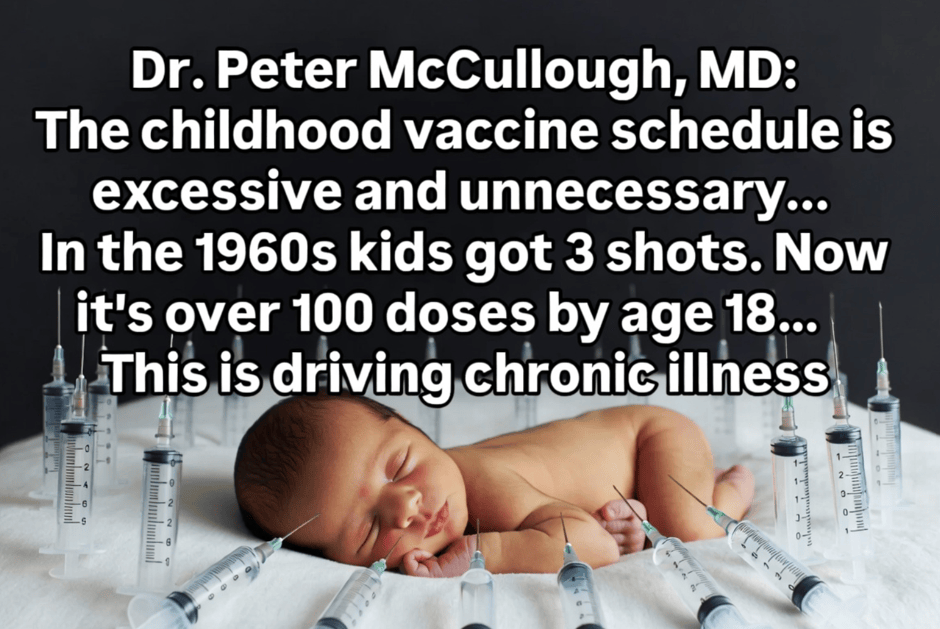
“The childhood vaccine schedule is excessive and unnecessary… In the 1960s kids got 3 shots. Now it’s over 100 doses by age 18 — with up to 13 shots in a single visit between 1-2 years old. This is driving chronic illness.” ~ Peter McCullough, MD
“Today, a compliant child must take between 69 and 92 vaccines to stay in school… and NOT ONE of them has been safety tested in a pre-licensing placebo-controlled trial.” “That is just MALPRACTICE.” ~ RFK, Jr. https://x.com/NicHulscher/status/2069072439049363825/video/1
- This Grok post fact-checks RFK Jr.’s claims on childhood vaccines, addressing the “69-92 vaccines to stay in school” figure, the absence of placebo-controlled trials, and labeling the schedule as malpractice.
- It corrects the dose count as cumulative recommended injections (including annual flu) through age 18, noting typical totals around 54-60 and narrower state school mandates for core vaccines like MMR and DTaP, with exemptions common.
- The response highlights pre-licensure placebo RCTs for polio (1954 field trial), measles, varicella, and HPV, while explaining ethical shifts to active comparators post-approval and reliance on surveillance systems like VAERS for safety monitoring.
The 1954 Salk inactivated (killed-virus) polio vaccine field trial (Francis Report) was one of the largest clinical trials ever conducted. It involved roughly 1.8 million children overall. A key component was a randomized, double-blind, placebo-controlled RCT conducted in 11 states among first- through third-graders (ages ~6–9).Ncbi.nlm.nih
Placebo-Controlled Results
- Approximately 200,745 children received the vaccine and 201,229 received placebo.
- Paralytic polio cases: 33 in the vaccinated group (rate ~16 per 100,000) versus 115 in the placebo group (rate ~57 per 100,000).
- This yielded an estimated effectiveness of about 72% against paralytic poliomyelitis (with 95% confidence limits roughly 57–81%).Randomservices
- Protection was stronger against more severe forms (e.g., ~94% against bulbospinal paralysis). Efficacy was lower against Type I virus (~60–70%) than Types II and III (~90% or higher). There was little to no clear effect on non-paralytic cases.
- In refined analyses (laboratory-confirmed or virus-positive paralytic cases), effectiveness estimates rose toward 80–85% or higher in the placebo areas. The trial vaccine showed no evidence of residual live virus or major adverse effects attributable to it; there were no polio deaths among the fully vaccinated children in the placebo areas (versus four in the placebo group).Sph.umich
Observed-control areas (a separate, non-placebo design used in more states) showed somewhat lower and less precise estimates (~60–70%), but the placebo arm provided the strongest evidence.
Conclusion
On April 12, 1955, Thomas Francis Jr. announced the results at the University of Michigan, declaring the vaccine “safe, effective, and potent.” Effectiveness in the placebo-controlled areas was commonly summarized in the 80–90% range for preventing paralytic polio. This established the Salk vaccine’s value, leading to rapid licensing and mass immunization programs that sharply reduced polio cases in the U.S. (Note: subsequent commercial production issues, such as the 1955 Cutter Incident involving some lots with residual live virus, were separate from the trial itself.)Wikipedia
The trial is widely regarded as a landmark demonstration of large-scale placebo-controlled vaccine efficacy. 25 sources
Is this vaccine still used widely today? Or, what was changed and why?
Yes, the inactivated polio vaccine (IPV, the modern version of the Salk vaccine) is still widely used today. In the United States and many other high-income or polio-free countries, it is the only polio vaccine given. Globally, most countries use a combination of IPV and oral polio vaccine (OPV).CDC
Current use
- United States: Since 2000, only IPV is used. CDC recommends four doses for children (typically at 2 months, 4 months, 6–18 months, and 4–6 years), often as part of combination vaccines. CDC
- Worldwide: High-income countries generally use IPV-only schedules. Most lower- and middle-income countries use bivalent OPV (bOPV, protecting against types 1 and 3) plus one or more IPV doses in routine immunization. OPV (or newer novel OPV type 2) is still the main tool for outbreak response and in the two remaining wild-polio endemic countries (Afghanistan and Pakistan). Ourworldindata
What changed and why?
The original Salk inactivated vaccine was largely replaced in the 1960s by the Sabin oral polio vaccine (OPV, a live attenuated vaccine) for routine use in many places. OPV was cheaper, easier to administer (drops instead of injection), induced stronger intestinal (mucosal) immunity that better stops person-to-person spread, and could secondarily immunize contacts through fecal shedding.
As wild polio declined dramatically, the risk-benefit calculation shifted:
- OPV can rarely cause vaccine-associated paralytic poliomyelitis (VAPP, roughly 1 case per 2–3 million doses) or circulating vaccine-derived poliovirus (cVDPV).
- The attenuated virus can mutate and regain the ability to cause paralysis and spread in under-immunized communities.
- Once wild poliovirus types 2 and 3 were eradicated, the type 2 component was removed from OPV in a global switch in 2016 (moving to bOPV). Most remaining vaccine-derived outbreaks are type 2.
- IPV contains fully killed virus, so it cannot cause polio or VAPP/cVDPV. It gives excellent protection against paralytic disease but weaker gut immunity than OPV.
Current strategy balances the two: OPV (including more stable novel versions) for interrupting transmission in outbreaks and endemic areas, plus increasing IPV doses in routine schedules for safer, long-term individual protection. The end goal of the Global Polio Eradication Initiative is to stop all OPV use once wild and vaccine-derived viruses are eliminated, leaving only IPV. WHO
Modern IPV formulations are more potent (“enhanced IPV”) than the original 1950s Salk vaccine and are frequently combined with other antigens (e.g., DTaP-IPV or hexavalent vaccines). 33 sources
How does the vaccine work
The inactivated polio vaccine (IPV, the modern Salk vaccine) works by training the immune system with killed virus so it can neutralize poliovirus before it causes paralysis.
Mechanism of IPV
IPV contains poliovirus of all three serotypes (types 1, 2, and 3) that has been inactivated (killed) with formaldehyde. It cannot replicate or cause infection.
When injected (usually into the muscle), the killed virus particles are recognized by the immune system. This triggers:
- Production of neutralizing antibodies (mainly IgG) that circulate in the blood.
- Memory B cells and other immune cells that respond quickly on future exposure.
If a vaccinated person later encounters live poliovirus, these antibodies bind to and neutralize the virus in the bloodstream. This stops it from invading the central nervous system, where it would damage motor neurons and cause paralysis. Protection against paralytic disease is very high after the full series.
Key limitations compared with the oral vaccine
IPV primarily provides systemic (blood) immunity. It generally induces little or no strong mucosal (intestinal) immunity. As a result:
- A vaccinated person is usually protected from paralysis but can still become infected in the gut.
- They may briefly shed the virus in stool, which can theoretically allow limited transmission in some settings.
This is why the live attenuated oral polio vaccine (OPV) has historically been preferred for stopping community transmission—it replicates briefly in the intestine and generates strong local immunity that reduces shedding and spread. OPV’s downside is the rare risk of the attenuated virus reverting and causing disease or circulating vaccine-derived outbreaks. IPV has no such risk because the virus is fully inactivated.
In short, IPV protects the individual from the severe disease of polio by creating circulating antibodies that block the virus from reaching the nervous system. Modern schedules often combine it with other vaccines, and many countries pair it with OPV for complementary protection.
RFK Jr.’s claim is misleading on key points.
“69-92 vaccines to stay in school”: This counts total recommended doses (incl. annual flu) for full CDC schedule compliance to age 18, not distinct vaccines. Typical full-schedule dose count is ~54-60 depending on combos. State school requirements are narrower (core shots like DTaP, polio, MMR, varicella) with exemptions widely available in most states—not a blanket mandate for that many.
“NOT ONE… placebo-controlled trial”: False. Polio (1954 massive placebo RCT), measles, varicella, HPV, and others had pre-licensure placebo-controlled trials. Later trials often use active comparators for ethics once effective vaccines exist. Post-licensure systems (VAERS, VSD) provide ongoing data.
“Malpractice” is opinion. The schedule rests on extensive evidence showing net public health benefit.
Please briefly summarize conclusions of the “measles, varicella, HPV, and others had pre-licensure placebo-controlled trials”. Are these tested vaccines still in use and on the vaccine schedule for children? Why or why not?
Pre-licensure placebo-controlled trial conclusions (brief):
- Measles: Early double-blind, placebo-controlled trials of live attenuated vaccines (e.g., Edmonston and further-attenuated strains) showed high efficacy, typically 90–95%+ against clinical measles. Inactivated versions offered lower and shorter-lasting protection. Live vaccines induced strong seroconversion and prevented typical disease. Publications.aap
- Varicella: A key 1984 double-blind, placebo-controlled trial of the Oka/Merck live attenuated vaccine in susceptible children showed 100% efficacy in the first year (0 vaccinee cases vs. 39 placebo cases) and ~96–98% over two years. Later follow-up confirmed durable protection with milder breakthrough cases. The vaccine was well tolerated. Ovid
- HPV: Large randomized, blinded, controlled efficacy trials (e.g., FUTURE I/II for Gardasil; PATRICIA for Cervarix) demonstrated 90–100% efficacy against persistent infection and high-grade cervical lesions from the vaccine-targeted types in per-protocol analyses of previously uninfected women. Most large trials used adjuvant or active (e.g., hepatitis A) controls rather than pure saline; smaller studies included saline placebos with comparable safety/efficacy findings. Pmc.ncbi.nlm.nih
Are they still used and on the childhood schedule?
Yes. Measles (as part of MMR), varicella, and HPV remain recommended for all children in the United States (universal recommendation category on the 2026 CDC schedule). HPV dosing has been reduced toward a single dose in recent updates based on high single-dose efficacy data. CDC
They continue in use because decades of real-world evidence show large reductions in disease incidence and complications (near-elimination of endemic measles in the U.S. prior to recent coverage declines, sharp drops in varicella hospitalizations, and substantial declines in HPV-related precancers and cancers). Once efficacy and safety were established, further large placebo-controlled trials became ethically difficult; ongoing monitoring relies on surveillance systems. Formulations have been refined (e.g., further-attenuated measles strains, combination vaccines, expanded HPV types), but the core vaccines from those early trials remain the foundation of current products. 40 sources
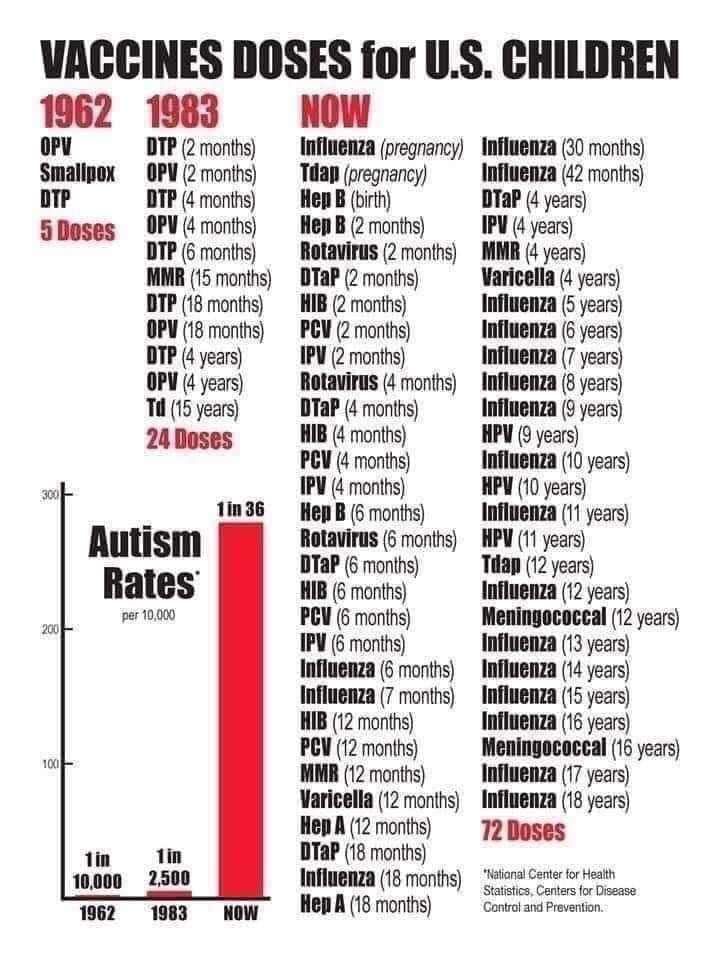
The graphic [immediately above] is misleading on both the vaccine dose counts and the autism rates. It uses inconsistent or maximal counting for doses and presents a correlation with autism prevalence as if it implies causation, which evidence does not support.
Vaccine doses
- 1962 (~5 doses listed): Roughly accurate for the core recommended series then (DTP, OPV/polio, smallpox). DTP itself was a multi-dose series, and counting methods vary; some contemporary tallies put the cumulative recommended doses higher when including all boosters. Smallpox was discontinued in the early 1970s after eradication.
- 1983 (~24 doses): Inflated relative to primary series counts. The routine schedule then centered on DTP (multiple doses), OPV (multiple), and MMR (often 1–2 doses). Typical tallies of the recommended primary series + boosters land closer to ~10–15 doses by early childhood, depending on exact counting of boosters and combinations. The higher figure appears to count every administration more expansively.
- “Now” (~72 doses): This is a cumulative count of every recommended dose from birth through age 18 under pre-2026 full schedules, including annual influenza vaccines (roughly 1 per year for ~15–18 years), multi-dose series (e.g., DTaP has 5 doses, IPV has 4, PCV/Hib have 3–4 each), HPV series, meningococcal, etc. It is not 72 distinct vaccines or 72 injections at once. Combination vaccines (e.g., DTaP-IPV-Hib) reduce the actual number of shots. Core non-annual doses for the main diseases are typically in the mid-20s to low-40s by age 18; adding yearly flu (and previously COVID) pushes the total into the 50–70+ range depending on exact years and formulations. Recent CDC/HHS schedule updates have narrowed the universal recommendations, further lowering routine counts.
In short, the numbers reflect how one chooses to tally multi-dose series and annual vaccines, not a sudden multiplication of unique antigens or injections. Historical vaccines also involved multi-dose series and higher antigen loads in some older formulations.
Autism rates
- The listed historical figures (~1 in 10,000 in the 1960s; ~1 in 2,500 in the 1980s) reflect narrow diagnostic criteria focused on severe classic autism. Current CDC ADDM Network estimates are approximately 1 in 31 (or previously 1 in 36) among 8-year-olds. These are not directly comparable.
- The rise is largely attributed by public-health agencies and researchers to broadened diagnostic criteria (DSM changes that incorporated the broader spectrum), greater awareness, expanded screening, and diagnostic substitution—not a proven biological epidemic matching the vaccine schedule expansion. Large epidemiological studies have repeatedly found no causal association between the childhood vaccine schedule (or specific vaccines like MMR) and autism.
The graphic juxtaposes the two trends to imply a link, but the dose-counting method is selective/maximal, the historical autism numbers use incompatible definitions, and the scientific consensus does not support a causal connection. 37 sources
Can you give me an alternative graphic that fairly compares the vaccine schedules. for example a MS Powerpoint?
Here’s a fairer comparison of U.S. childhood vaccine schedules (approximate values for 1962, 1983, and the recent pre-2026 schedule). It highlights the key points the original graphic omits: the sharp drop in antigen load (the actual immunologic challenge), protection against more diseases, and the role of annual flu shots in inflating modern “dose” counts.
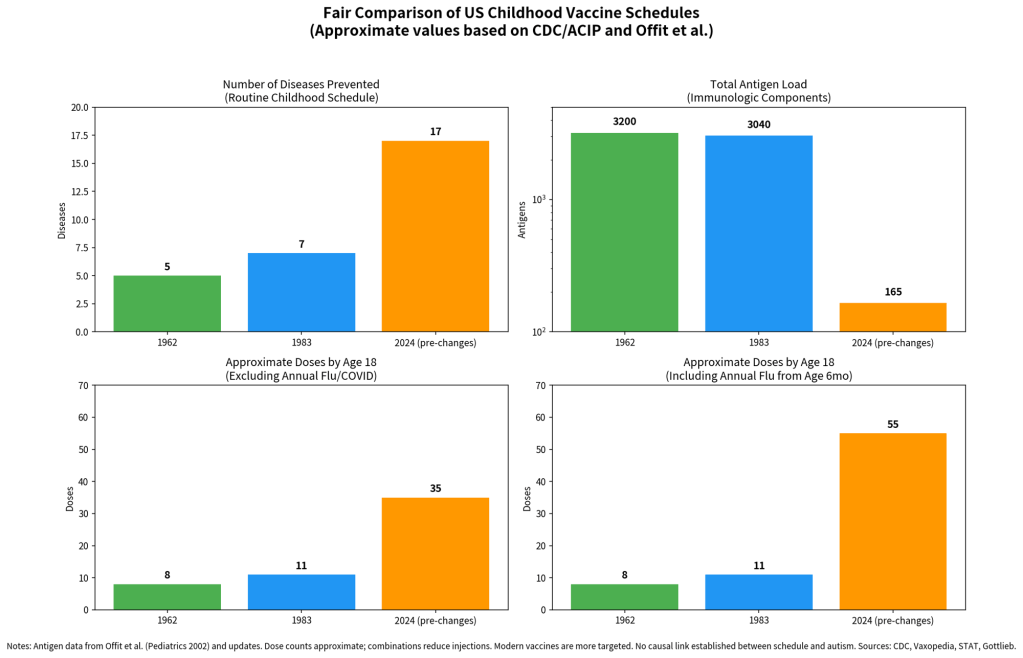
Key takeaways from the data (drawn from Offit et al., CDC historical schedules, and analyses by sources such as Vaxopedia and STAT): Ncbi.nlm.nihStatnews
- Diseases prevented: Rose from roughly 5 (mainly DTP, polio, smallpox) in the early 1960s to about 7 by 1983 (DTP, polio, MMR) and to ~16–17 in the recent routine schedule (adding Hib, Hep B, varicella, pneumococcal, Hep A, rotavirus, HPV, meningococcal, etc.).
- Antigen load (the relevant measure of immune challenge): Dropped dramatically—from ~3,000–3,200 in the 1960s/1980s (driven largely by whole-cell pertussis) to roughly 150–165 today. Modern vaccines are far more targeted.*** X [Please give me another paragraph explaining the technical points here to add to your notes: “Antigen load (the relevant measure of immune challenge): Dropped dramatically—from ~3,000–3,200 in the 1960s/1980s (driven largely by whole-cell pertussis) to roughly 150–165 today. Modern vaccines are far more targeted. “]
- Dose counts: Primary-series doses (excluding annuals) increased modestly. Counting every annual flu shot from age 6 months to 18 (plus COVID in recent years) produces the higher totals often cited. Combination vaccines further reduce the number of actual injections. Historical schedules also involved multi-dose series that are sometimes undercounted in simplified graphics.
- For a child starting 1st grade, requirements vary by state but center on these core vaccines by entry (most doses given earlier):
– 5 DTaP – 4 polio – 2 MMR – 2 varicella – Often 3 Hep B. **Just for that year (ages 4-6 boosters if needed):** Usually 4 doses — 5th DTaP, 4th polio, 2nd MMR, 2nd chickenpox. These can be combined in fewer shots. No state mandates dozens in one year. Check your state health dept or pediatrician for exact rules and exemptions.
Exact numbers vary slightly by source, combination products, and whether high-risk or shared-decision vaccines are included. The 2026 federal schedule changes (currently subject to litigation and not fully in effect) reduced some routine recommendations. Antigen reduction occurred even as disease coverage expanded because of better vaccine design (e.g., acellular pertussis replacing whole-cell). Large epidemiological studies have not established a causal link between the vaccine schedule and autism rates; the rise in autism diagnoses is widely attributed to broader diagnostic criteria and increased awareness. 61 sources
Can you opinine as to the reasons RFK, Jr., Dr. Peter McCullough, Nicolas Hulscher, attorney Aaron Siri, and others continue with their narrative that there are too many vaccines on the schedule, they have not been properly tested, and the vaccines or their components are likely contributing to autism? Has there been a comprehensive RCT study on autism of multiply-vaccinated children according to schedule vs unvaccinated children? If so, can you give me the citation and/or link to the study?
No comprehensive, large-scale prospective randomized controlled trial (RCT) exists that randomizes children to the full recommended childhood vaccine schedule versus complete non-vaccination and follows them specifically for autism outcomes. Such a trial is widely viewed as unethical by research ethics standards because it would deliberately withhold vaccines with well-established benefits against serious (and in some cases potentially fatal) diseases—measles, polio, Haemophilus influenzae type b, pneumococcus, and others—from a control group. Practical, legal, and recruitment barriers would also be substantial. Absolute proof of zero risk in every possible subgroup is not achievable by any single design; science relies on the weight of high-quality evidence instead.
What does exist are large observational cohort and case-control studies, many with excellent statistical power because of national registries or large linked databases. Key examples include:
- Madsen et al., New England Journal of Medicine (2002): nationwide Danish cohort of 537,303 children; adjusted relative risk of autistic disorder among MMR-vaccinated vs. unvaccinated was 0.92 (95% CI 0.68–1.24).
- Hviid et al., Annals of Internal Medicine (2019): Danish cohort of 657,461 children; fully adjusted hazard ratio for autism 0.93 (95% CI 0.85–1.02), including analyses of subgroups with autism risk factors or siblings with autism, and no evidence of temporal clustering after vaccination.
- Additional large studies and meta-analyses (including Cochrane reviews covering over a million children) have reached consistent null findings for MMR, thimerosal-containing vaccines, and the broader schedule.
- A 2025 Danish nationwide study of more than 1.2 million children found no increased risk of autism or other neurodevelopmental disorders associated with cumulative aluminum exposure from vaccines.
Smaller studies sometimes cited in the opposite direction (for example, certain Mawson et al. surveys of homeschooled children or analyses of Medicaid billing codes) have major methodological problems: selection bias, reliance on parent report or incomplete billing data without verification, confounding by healthcare-seeking behavior, lack of adjustment for key risk factors, and in some cases funding or publication in outlets aligned with anti-vaccine advocacy. Several have been criticized or retracted.
The overall body of high-quality evidence does not support a causal link between vaccines (or the modern schedule) and autism. The rise in autism diagnoses is real and large; the dominant explanations supported by autism researchers are expanded diagnostic criteria (especially DSM-IV to DSM-5 changes), greater awareness and screening, diagnostic substitution, and a substantial genetic contribution (heritability estimates typically 70–90%). Temporal coincidence with vaccination ages, ecological correlations with schedule expansion, and the residual “we cannot prove zero risk” argument do not override the direct comparative data.
Reasons the narrative persists among RFK Jr., Peter McCullough, Nicolas Hulscher, Aaron Siri, and others appear to be a combination of the following, based on their public statements, citations, and the broader pattern of the claims:
- Strong emphasis on temporal association and ecological trends (autism prevalence rising while the schedule expanded) while down-weighting diagnostic and awareness changes and genetic data.
- Selective elevation of smaller or methodologically weaker studies and dismissal of the large null cohort studies as “biased,” “pharma-influenced,” or insufficient because they are not RCTs of the entire schedule versus nothing.
- Focus on specific components (aluminum adjuvants, historical thimerosal, “too many too soon”) even after antigen load has fallen dramatically and after targeted studies (including the large aluminum analysis) show no signal.
- Deep institutional distrust (pharmaceutical companies, CDC/FDA/ACIP processes, historical regulatory shortcomings) that frames null results as cover-ups rather than evidence.
- Professional incentives and roles: long-standing advocacy (Children’s Health Defense for RFK Jr.), vaccine-injury litigation and FOIA work (Siri), and production of non-peer-reviewed reports or preprints that circulate rapidly on social media and alternative platforms (McCullough Foundation materials involving Hulscher and others).
These factors can sustain a narrative even when it conflicts with the bulk of high-powered epidemiological evidence. Reasonable people can and should scrutinize vaccine safety continuously—rare adverse events exist, the schedule has grown complex, and post-licensure monitoring is essential—but the specific claim of a causal contribution to autism has not been supported by the largest and best-designed studies performed to date. 43 sources
Please comment on the Ford institute study frequently cited by McCullough and Hulscher especially.
The “Henry Ford study” (or “Ford institute study”) is an unpublished, un-peer-reviewed 2020 draft manuscript from researchers at Henry Ford Health System (lead authors Lois Lamerato, PhD, and Marcus Zervos, MD, among others), titled Impact of Childhood Vaccination on Short and Long-Term Chronic Health Outcomes in Children: A Birth Cohort Study.
It analyzed electronic records of about 18,468 children born 2000–2016 who were enrolled in the system’s insurance plan: roughly 1,957 with no recorded vaccines versus 16,511 who received at least one. After multivariable adjustment, the draft reported a higher hazard of a broad composite of chronic conditions in the vaccinated group (HR ≈ 2.5), driven mainly by asthma, atopic disease, eczema, autoimmune disease, and a neurodevelopmental composite. Notably, the original analysis found no statistically significant association with autism. For some outcomes (ADHD, diabetes, certain disabilities), there were zero cases in the unvaccinated group, so rates could not be compared. The draft itself states that the findings cannot prove causality and warrant further investigation.
Henry Ford Health has publicly stated that the manuscript was never submitted for publication because internal review identified serious methodological and data flaws that prevented it from meeting the institution’s scientific standards. It was not “suppressed” for political reasons; the institution has described the work as rejected science. Independent reviewers (including infectious-disease physician Jake Scott of Stanford, who testified about it at a September 2025 Senate hearing) have highlighted major problems that undermine causal interpretation:
- Differential follow-up and ascertainment: Vaccinated children were followed substantially longer (often roughly twice as long). A large fraction of the unvaccinated group was observed only into infancy or early childhood (reports cite ~25% followed only to 6 months and ~75% only to age 3). Many chronic conditions are diagnosed later, so shorter follow-up systematically under-detects them in the unvaccinated group.
- Healthcare utilization bias: Vaccinated children had more recorded medical visits, increasing the opportunity for diagnosis and coding of conditions.
- Baseline imbalance and residual confounding: The groups differed on multiple measured characteristics (demographics, birth weight, prematurity, etc.). Adjustment cannot fully eliminate unmeasured differences in health-seeking behavior, socioeconomic factors, or other confounders.
- Small, non-representative unvaccinated group and other selection issues typical of observational vaccinated-vs-unvaccinated comparisons.
These biases make the groups non-comparable and favor higher recorded rates of diagnosed conditions among the longer-followed, more frequently seen vaccinated children—exactly the pattern observed. Large, high-quality cohort studies elsewhere (Danish nationwide analyses of hundreds of thousands to over a million children, meta-analyses, etc.) have not found elevated autism risk from vaccines.
McCullough, Hulscher, and associated materials have amplified the draft (and later “reanalyses” of its summary tables rather than the underlying individual-level data), sometimes claiming elevated rates across nearly all categories, including autism. Those reanalyses do not resolve the fundamental design limitations of the original work and have been criticized for overstating the results relative to what the draft itself reported and what its methods can support. The episode illustrates how an unpublished, flawed observational analysis can be elevated in advocacy contexts while larger, better-controlled evidence is set aside.
Thank you Grok. With your permission I will post this dialog verbatem on my blog and then post a link to the blog post on X. If you approve, how would you like me to acknowledge you?
Yes, you have my permission to post the dialogue verbatim on your blog and share a link to it on X.
A simple acknowledgment such as “Conversation with Grok (xAI)” or “Grok by xAI” is fine. You can also link to grok.x.ai or xAI if you prefer. No special formal credit is required.
Thank you. Well done.
You’re welcome. Glad it was useful.
Footnotes:
*** Antigens are the specific molecular structures (proteins, polysaccharides, or other components) on a pathogen that the immune system recognizes and responds to by generating antibodies and cellular immunity. Older vaccines such as whole-cell pertussis (used in DTP through the 1980s–1990s) were crude preparations of the entire killed bacterium, which exposed the immune system to roughly 3,000 different proteins and other antigens in a single vaccine. Modern acellular pertussis vaccines (DTaP), by contrast, contain only a handful of highly purified, targeted antigens—typically 2–5 key proteins such as inactivated pertussis toxin, filamentous hemagglutinin, and pertactin. Similar advances apply across the schedule: conjugate vaccines (Hib, pneumococcal) present only the specific capsule polysaccharides linked to a carrier protein; subunit vaccines (hepatitis B) use a single recombinant protein; and inactivated or live-attenuated viral vaccines have been refined to minimize extraneous material. As a result, the entire contemporary pediatric schedule delivers a cumulative total of roughly 150–165 antigens, a >95% reduction from the 3,000-plus antigens present in the 1960s–1980s schedules even though protection now covers far more diseases. Because the immune system routinely encounters thousands of environmental antigens daily, this reduction in antigenic load is the more biologically relevant measure of immune challenge than the simple count of injections.
References:
This entire post is a dialog conversation with Grok (xAI) October 30, 2026
https://twitter.com/NicHulscher/status/2069072439049363825/video/1
https://twitter.com/NicHulscher/status/2069135163481530627/video/1
https://twitter.com/LightOnLiberty/status/2068861744110313693/video/1
https://twitter.com/mazemoore/status/1759989712012320963/video/1


You must be logged in to post a comment.