
Excellent science work product here. Conclusion: “This finding is a serious weakness in the theory of anthropogenic global warming by way of rising atmospheric CO2 attributed to the use of fossil fuels in the industrial economy; and of the “Climate Action proposition of the UN that reducing fossil fuel emissions will moderate the rate of warming by slowing the rise of atmospheric CO2.” My summary: after careful statistical testing, there is very poor correlation between the observed increasing trend in atmospheric CO2 concentration versus the increasing atmospheric CO2 emissions from burning fossil fuels. The primary contention of global warming proponents is refuted.

FIGURE 1: FOSSIL FUEL EMISSIONS AND ATMOSPHERIC COMPOSITION
FIGURE 2: EMISSIONS AND CHANGE IN ATMOS-CO2 AT FIVE TIME SCALES
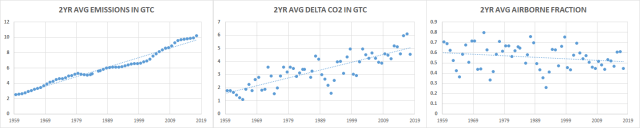

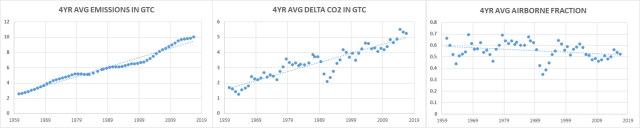
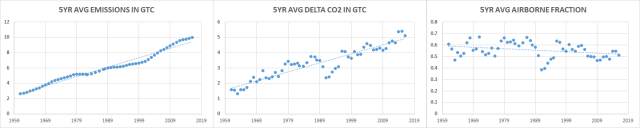
FIGURE 3: CORRELATION BETWEEN ΔCO2 AND EMISSIONS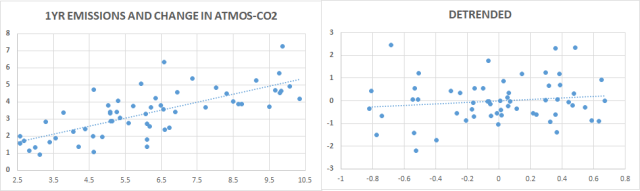
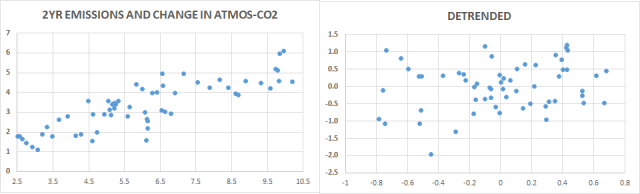

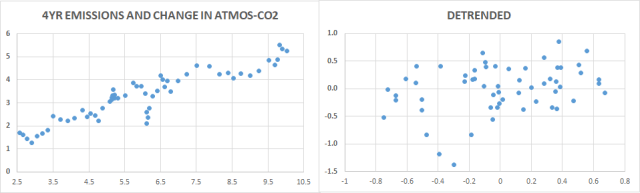
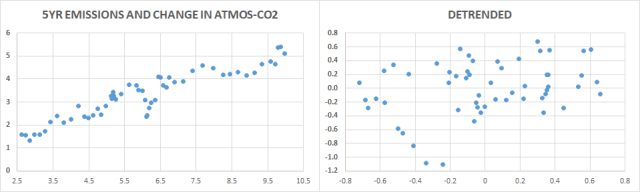
FIGURE 4: SUMMARY OF AIRBORNE FRACTION

FIGURE 5: SUMMARY OF CORRELATION ANALYSIS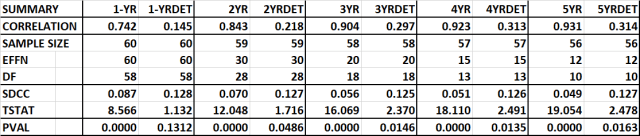

- Figure 1 shows that atmospheric CO2 concentration as measured at Mauna Loa has been rising steadily since 1958 while at the same time post industrial humans have been injecting increasing amounts of carbon dioxide from fossil fuels into the atmosphere. It is in this context that the usual assumption is made that observed changes in atmospheric CO2 concentration (ΔCO2) are driven by fossil fuel emissions. This assumed relationship appears to be visually validated in the left panels of the five charts in Figure 3 where changes in atmospheric carbon dioxide (ΔCO2) appear to be strongly correlated with the rate of emissions.
View original post 6,067 more words

 budbromley
Pingback: Fossil Fuel Emissions and Atmospheric Composition — budbromley – Climate- Science.press